Historical Timeline
Hoboken, New Jersey 1978-1982
Between 1978 and 1982, dozens of fires ripped through tenements and rooming houses in the square-mile city of Hoboken, New Jersey. The blazes killed fifty-six people, most of whom were children, and left more than eight thousand homeless. Almost all of the displaced residents were Puerto Rican; most never returned to Hoboken. Nearly every fire, investigators determined, had been the result of arson. This rash of destruction, dislocation, and death occurred alongside another dramatic story: a transformation the local and national press hailed as the “Hoboken Renaissance.” Beginning in the late 1960s, the traditionally working-class city of 45,000, located just across the Hudson River from Manhattan, experienced a sudden influx of middle-income people. Homesteaders looking for historic brownstones made up the first wave of the “Renaissance.” By the end of the 1970s, thousands of young professionals joined them, attracted to Hoboken more for its proximity to Wall Street and corporate headquarters than for its distinctive architecture.
These two narratives, one of death, another of rebirth, competed for readers’ attention in newspapers across the metropolitan area. Coverage alternated between breathless profiles of brownstone renovations and grisly tallies of the dead and injured. In truth, the stories of destruction and resurgence were one and the same. Hoboken’s arson wave resulted from a new phase of metropolitan transformation, as owner-occupied brownstone renovations gave way to landlords renovating tenements into luxury apartments. As the potential rent or sale price for converted units soared at the end of the 1970s, property owners faced powerful incentives to displace low-income tenants market-rate units. Hoboken’s old tenement buildings rapidly became condominiums: from 41 units in 1981 to 3,500 built or proposed units by 1986. In 1982, over oysters and white wine, newly arrived stockbrokers discussed the benefits of the Hoboken-to-Manhattan commute just a half block from where an arson-related fire had killed twelve people a day earlier. “I don’t want people to be burned,” one remarked, “but I wouldn’t mind a nicer element of people here, if you know what I mean.”
Excerpt from Hoboken Is Burning: Yuppies, Arson, and Displacement in the Postindustrial City
1930's
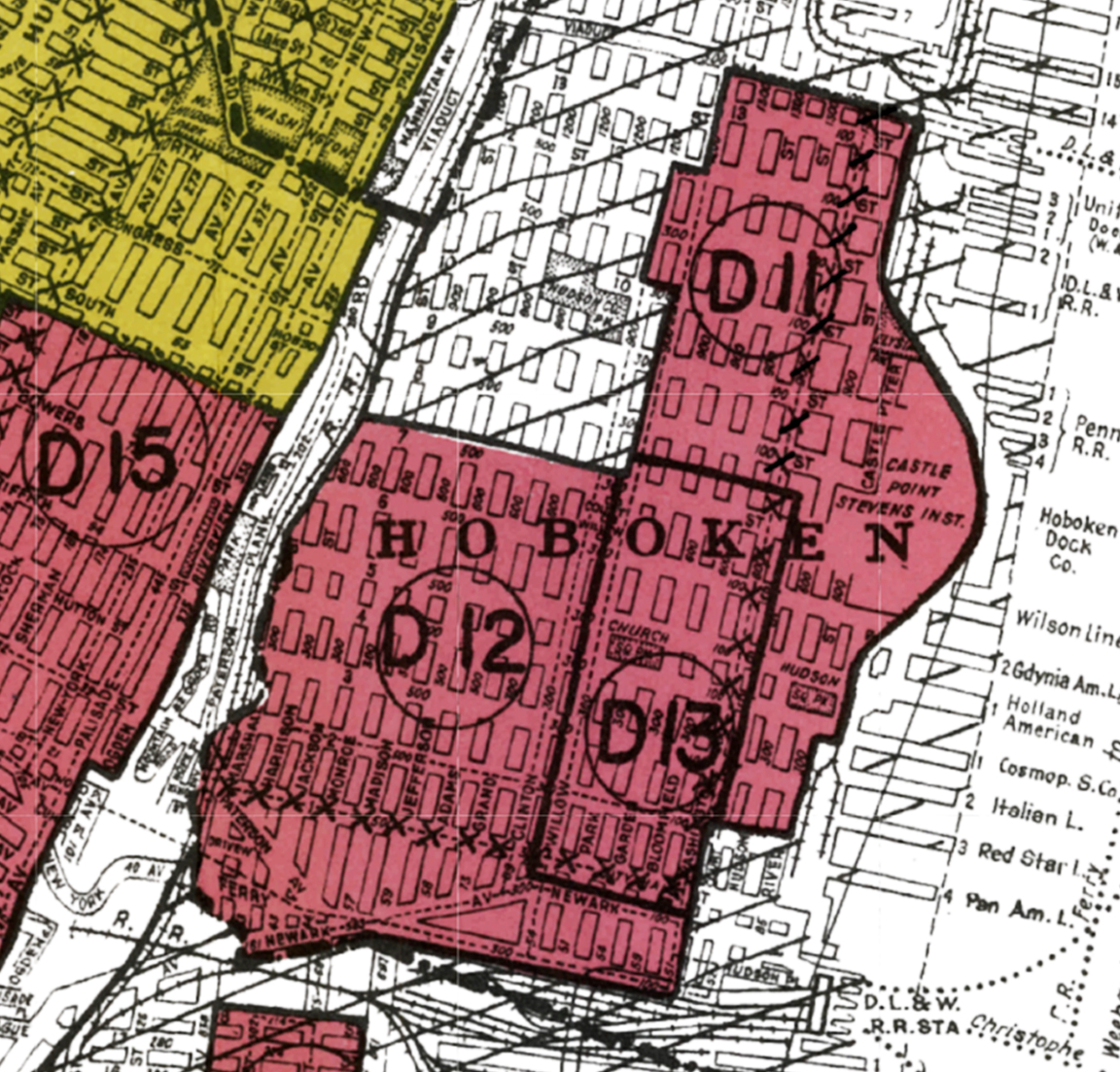
Redlining
1960's
Containerization
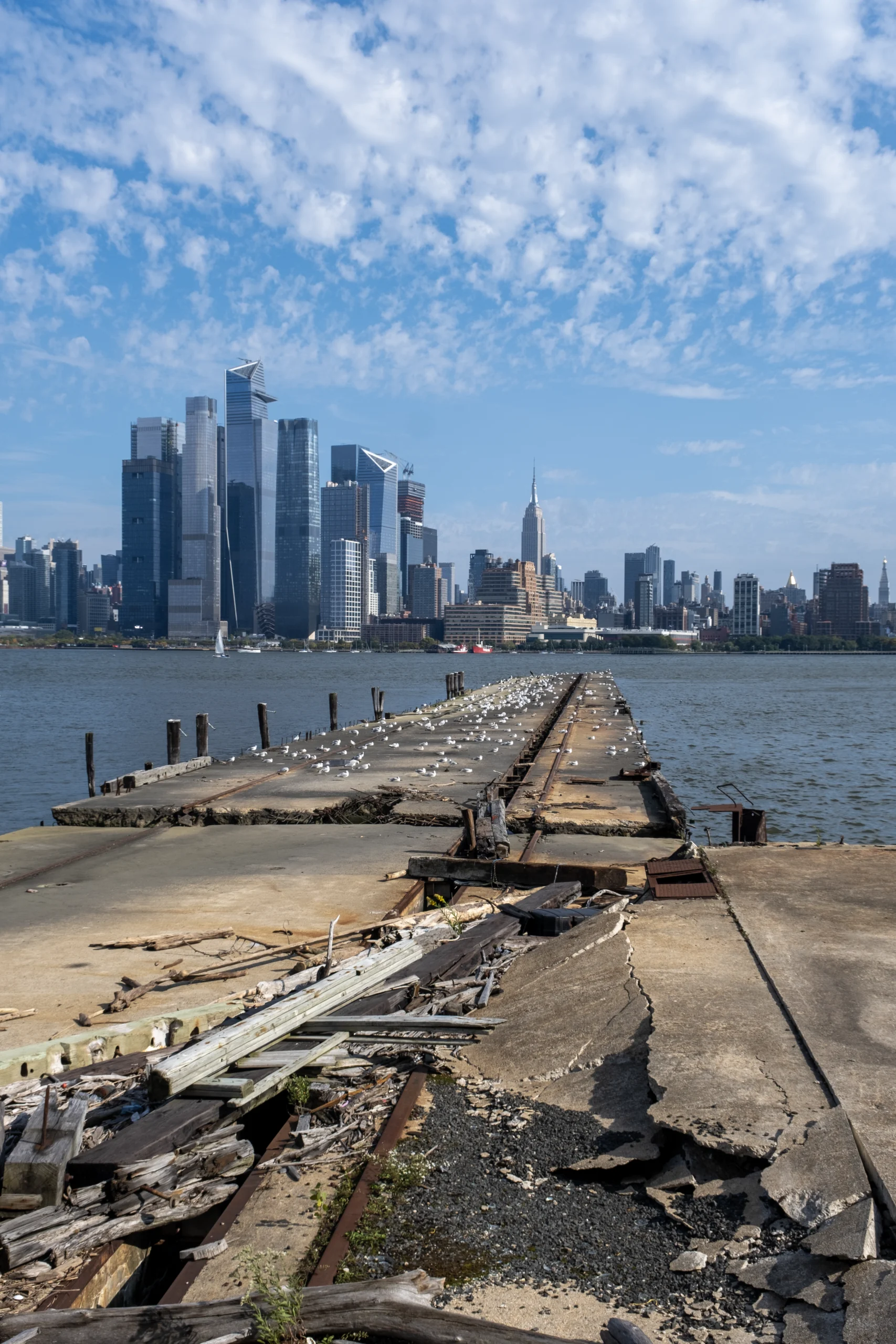

Hoboken’s economy suffers detrimental decline due to shipping containerization. The huge shipping waterfront ports masterminded by John Stevens, did not have enough land mass to cater to this new industry that provided more convenient compact methods. This industry forced Hoboken out of shipping as it moved to either neighboring Newark or Southern states. The industry itself hurt physical labor that many residents relied on in that less people were needed overall.
1967
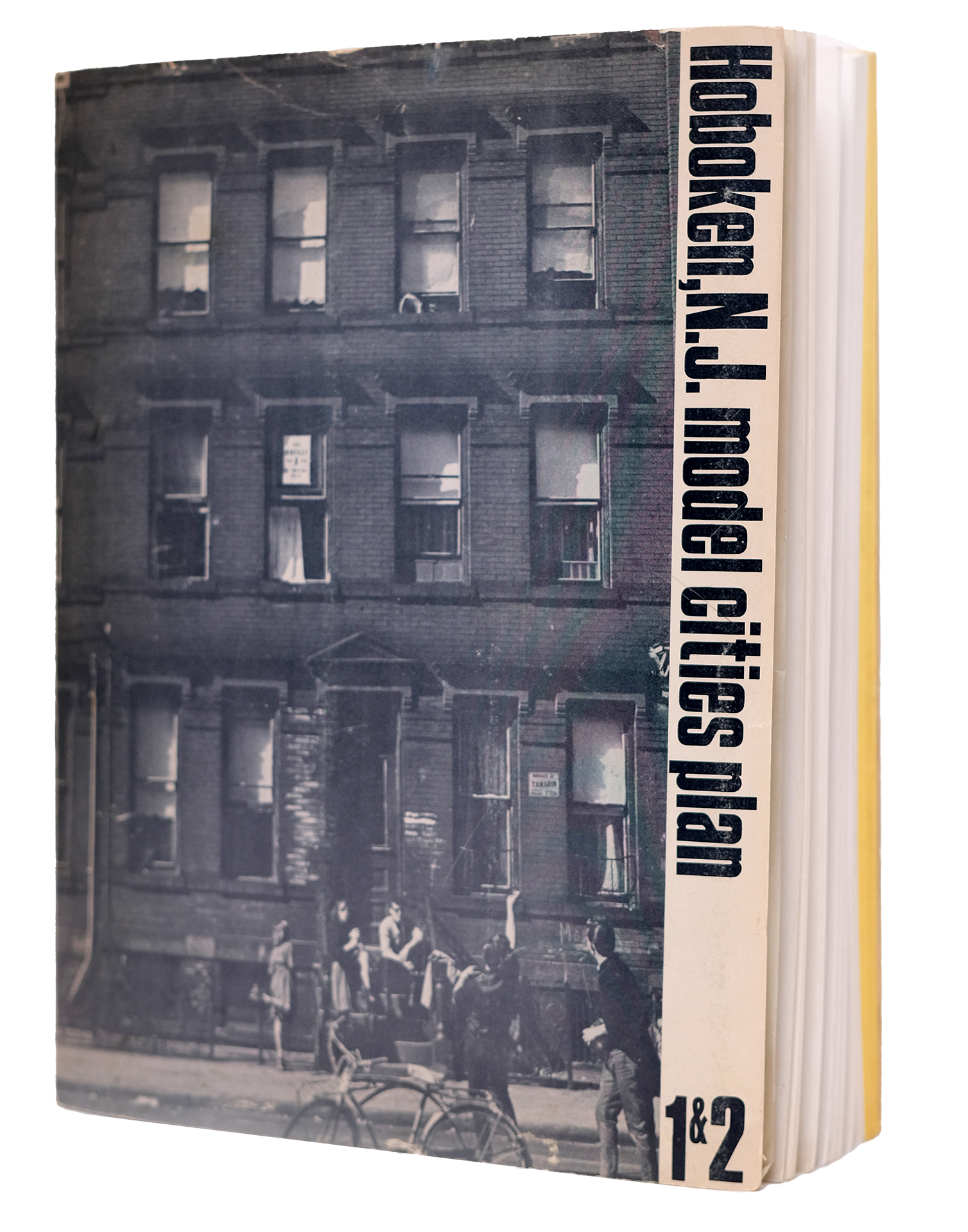
The Model Cities Program
View Footnote
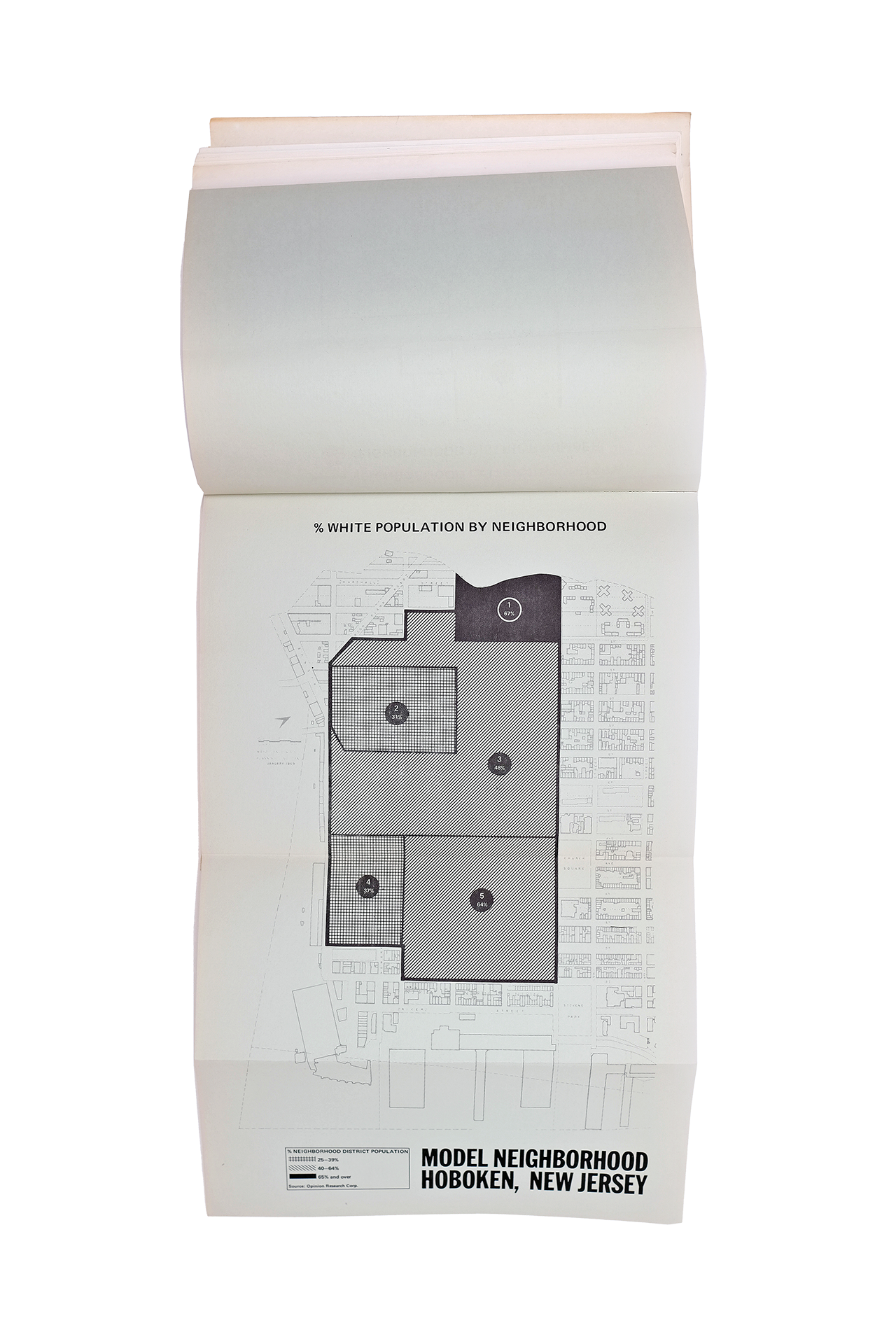
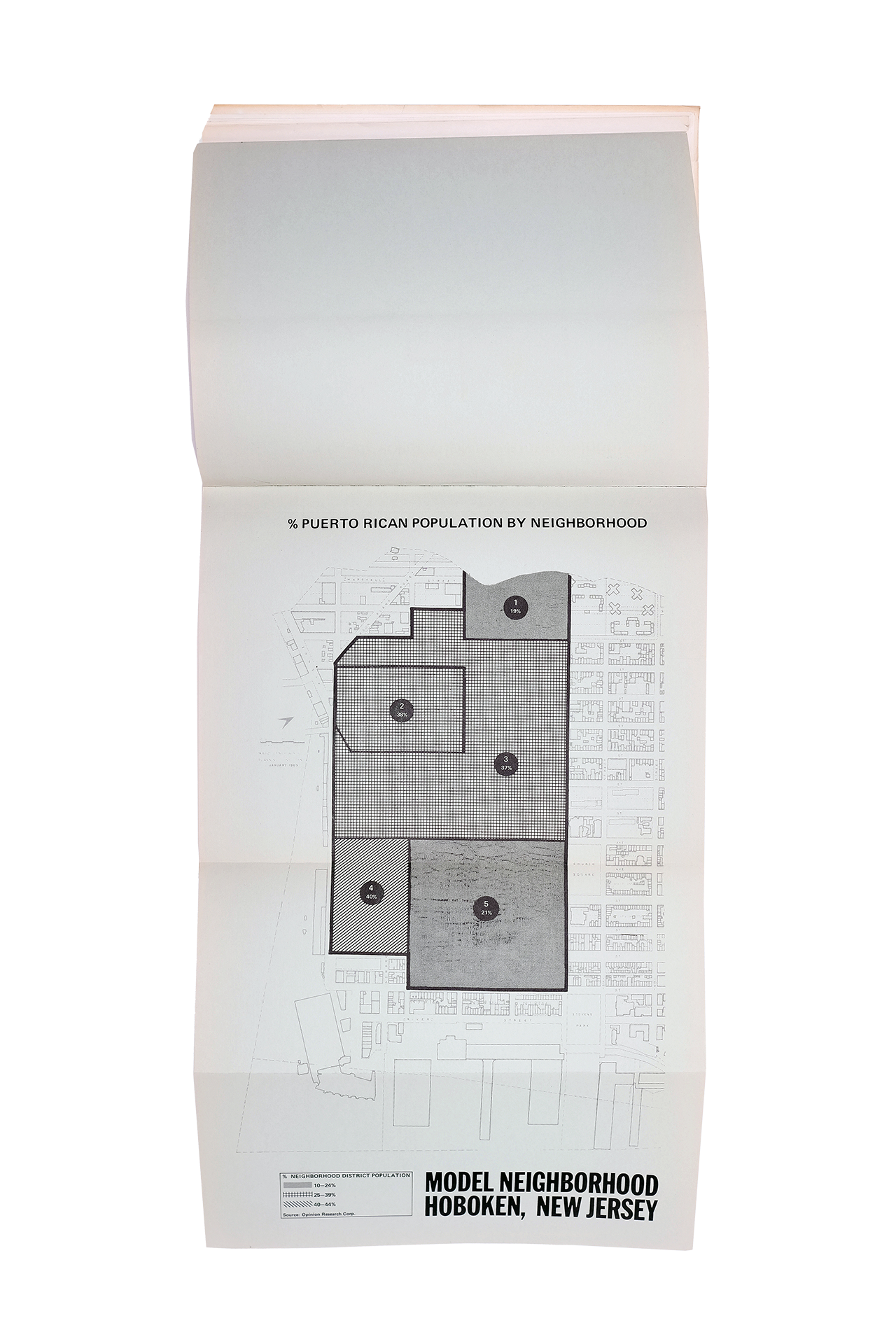
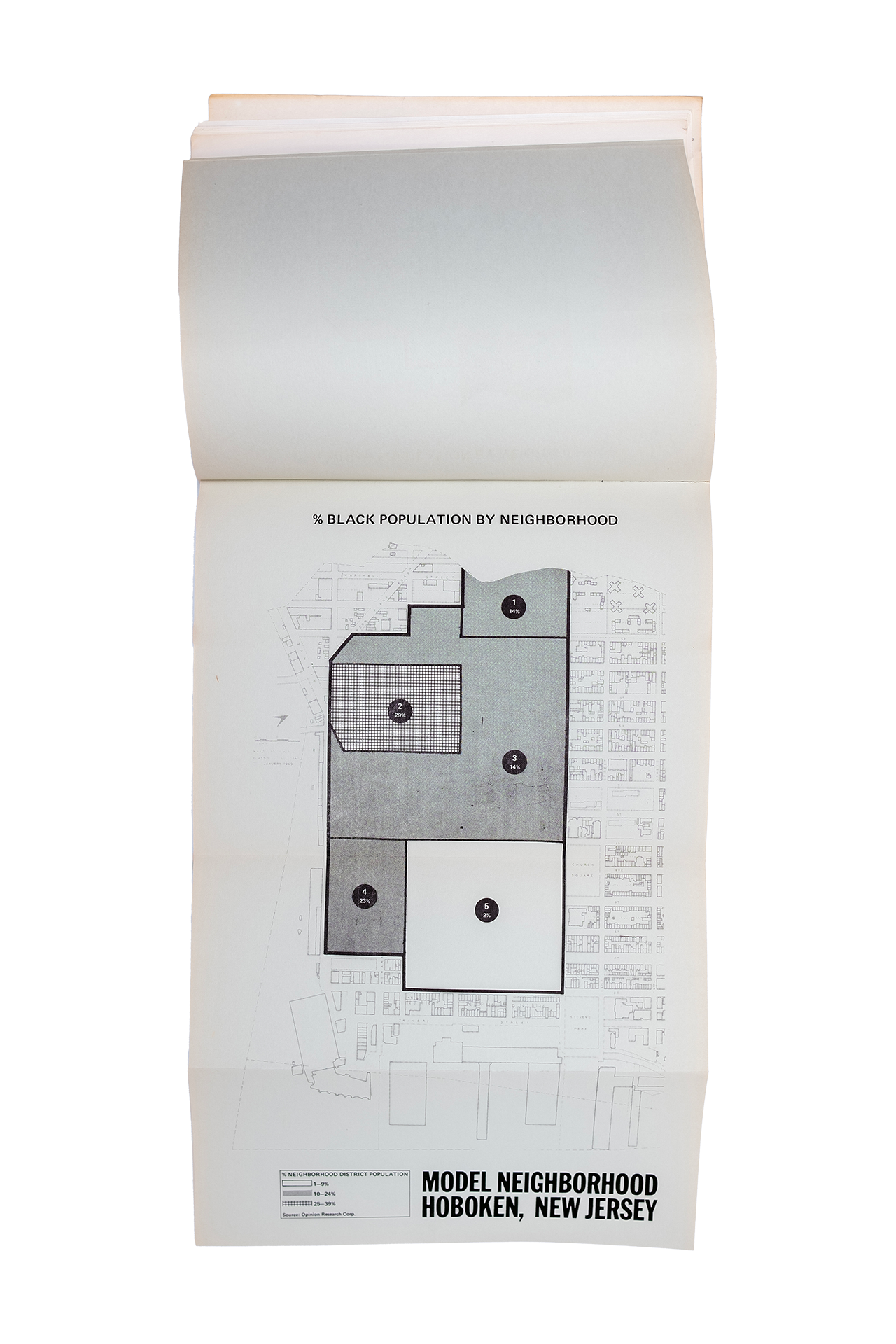
Lesser displacements occurred in zones 1, and 5 where predominantly white populations resided.
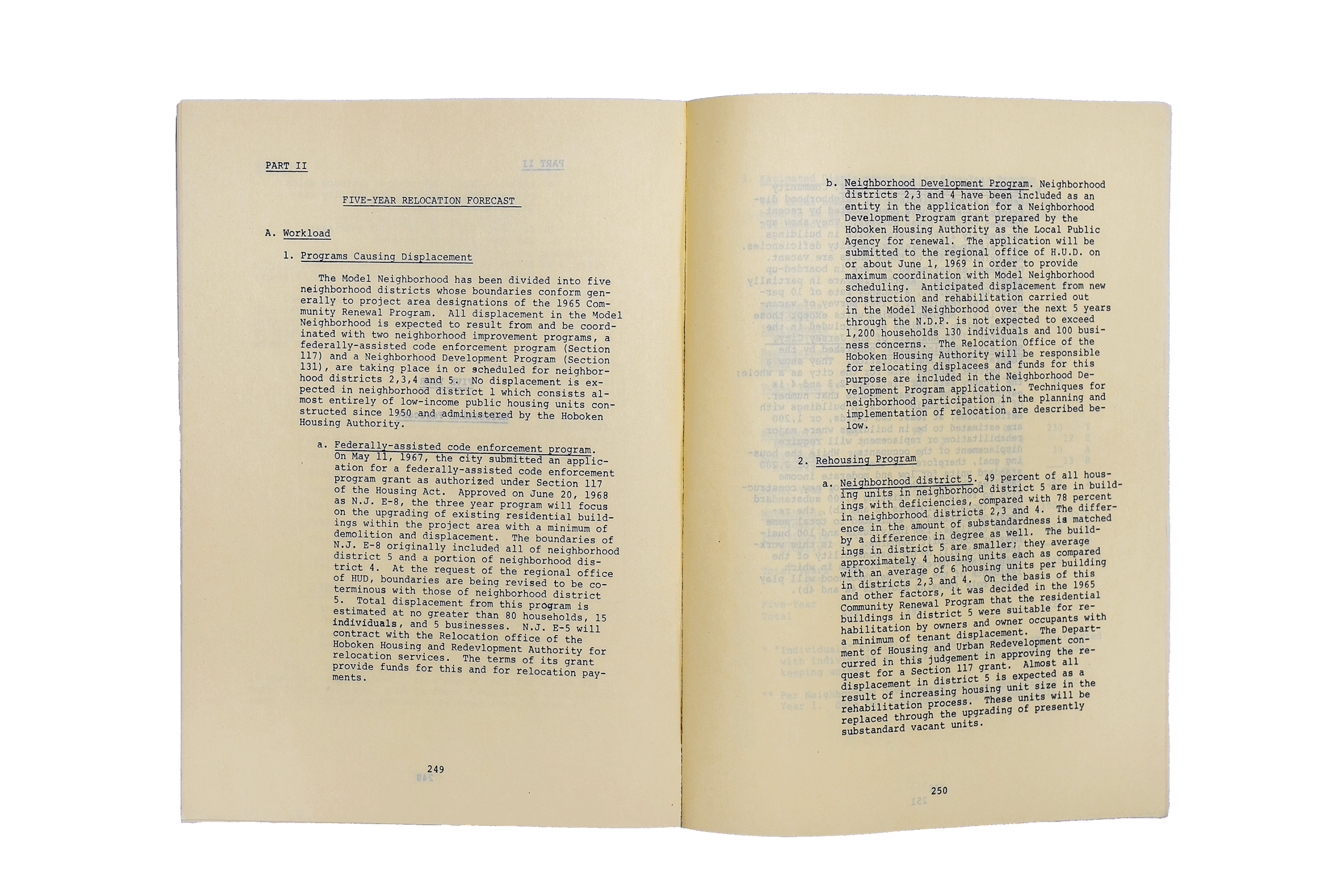
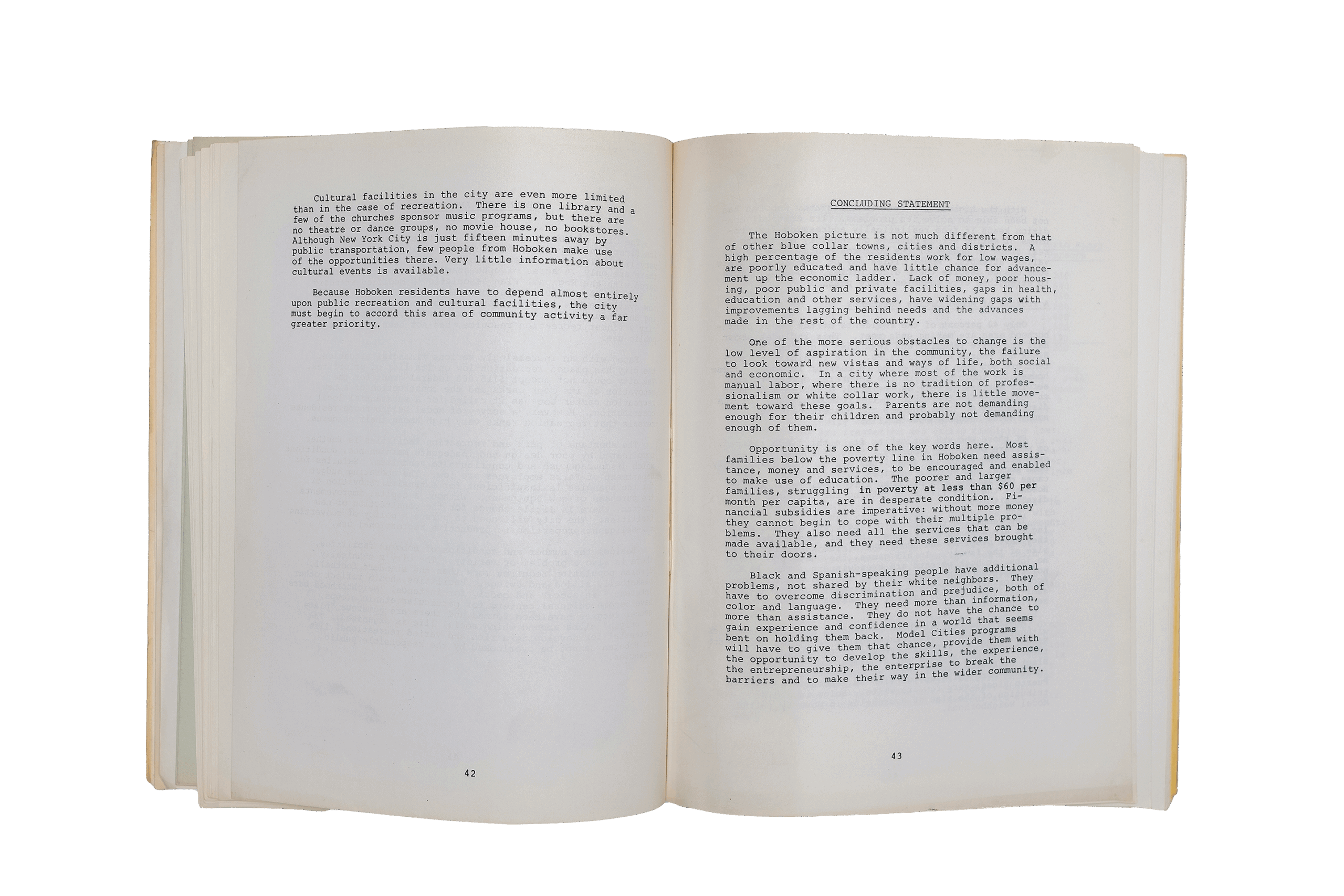
Lyndon B. Johnson’s Great Society program is enacted with a sub section called The Model Cities Program. Several anti-poverty initiatives were enacted including an after-school tutoring program, a job-training course, a family-planning clinic, and improvements to the city’s parks and swimming pools. By 1969, private engineering firm, Mayo Lynch, represents Hoboken and draws up the original application for “Model Cities Funds” which was submitted in 1970.
1973
Reallocation of Model Cities Funds
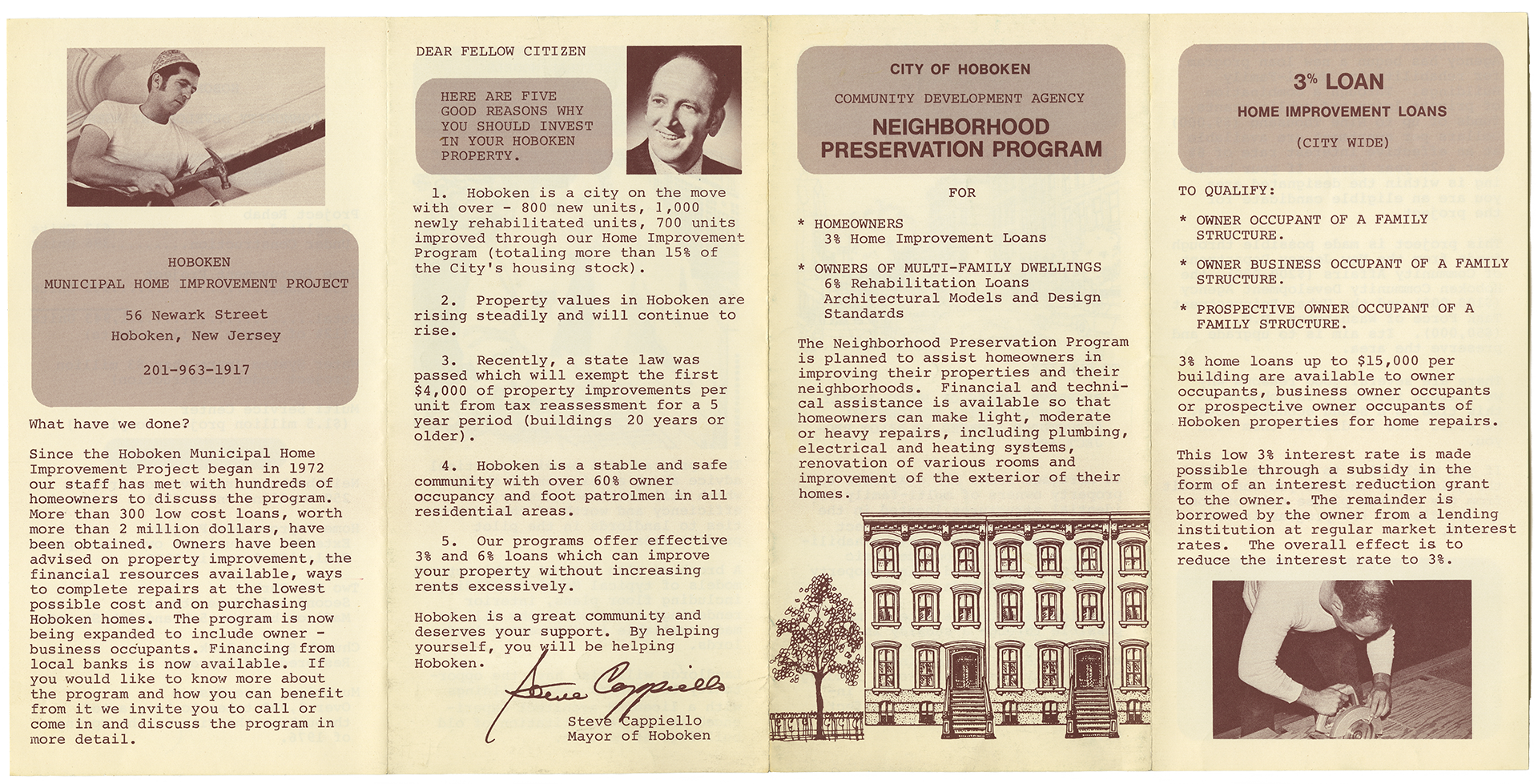
The funds are received and a Model Cities Agency has now been formed in Hoboken. The use of the funds marks the first benchmark signs of gentrification. The agency begins to apply a major focus on its Home Improvement Program (HIP) a subprogram of MCP that collaborates with the federal Housing and Urban Development (HUD). These offices introduced what they referred to as a “rehabilitation” that would later introduce the term “renaissance” into the city’s language. The city manipulates “urban renewal” funds by stripping public funds and allocating them into subsidies for low interest rates of brownstones targeting semi-affluent middle class people from outside the city, mainly people from the New Jersey suburbs. These new “adventure seekers” or “pioneers” as dubbed by the media, were now able to mortgage property at a 3% interest rate as opposed to the 9% standard national rate. The purchase of these properties were not afforded to residents mainly because of the racist history of redlining that had occurred decades before.
1975
Community Development Agency
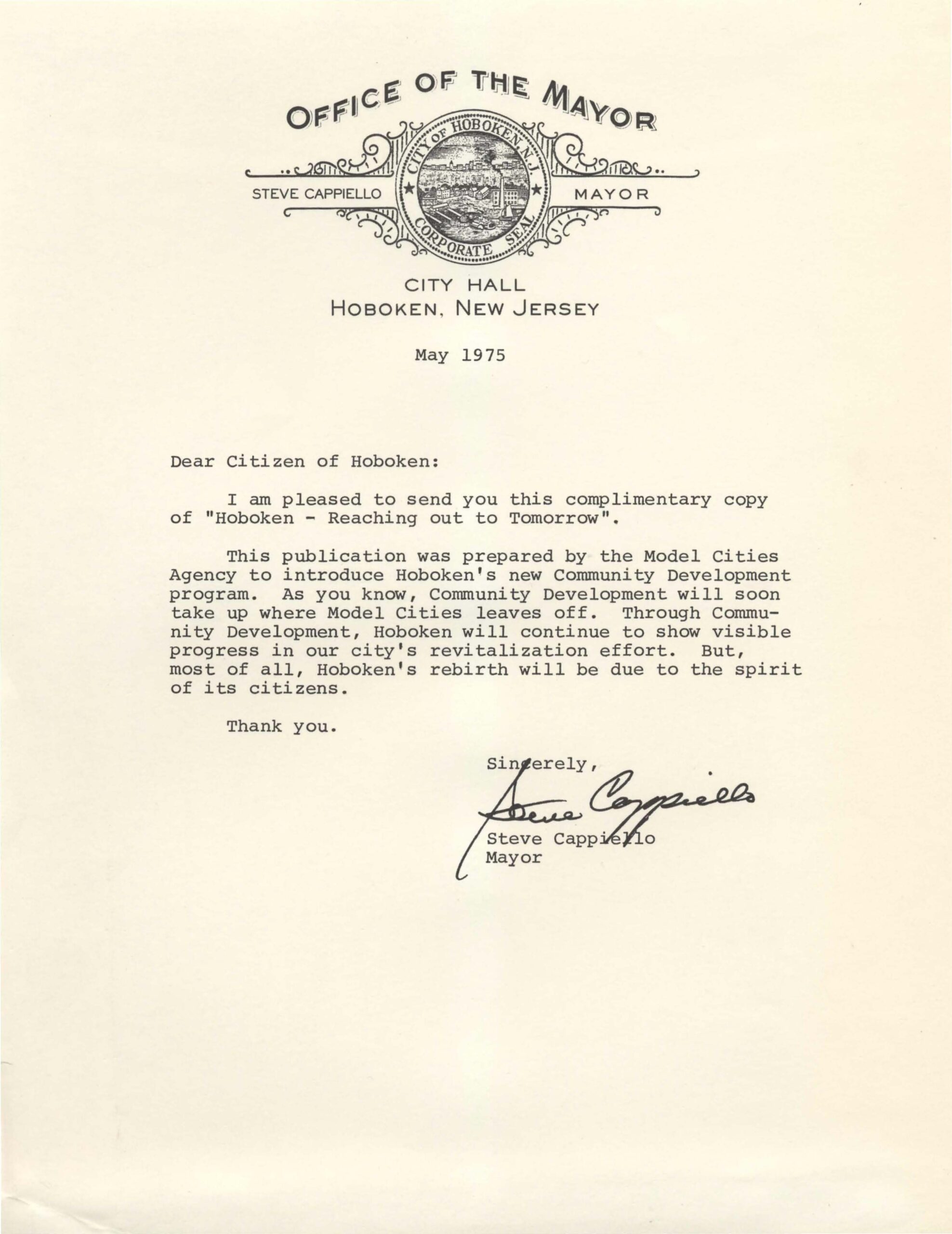
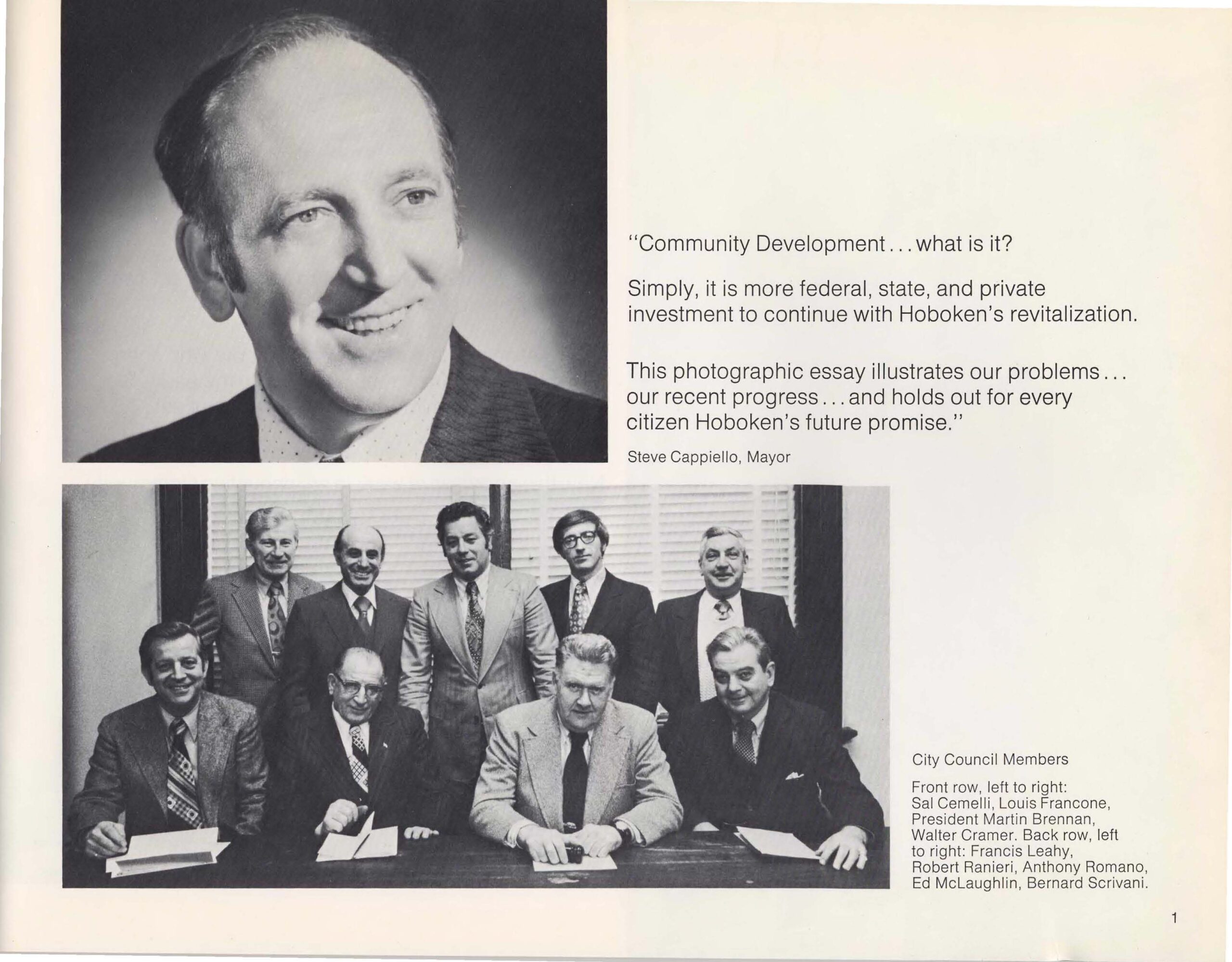
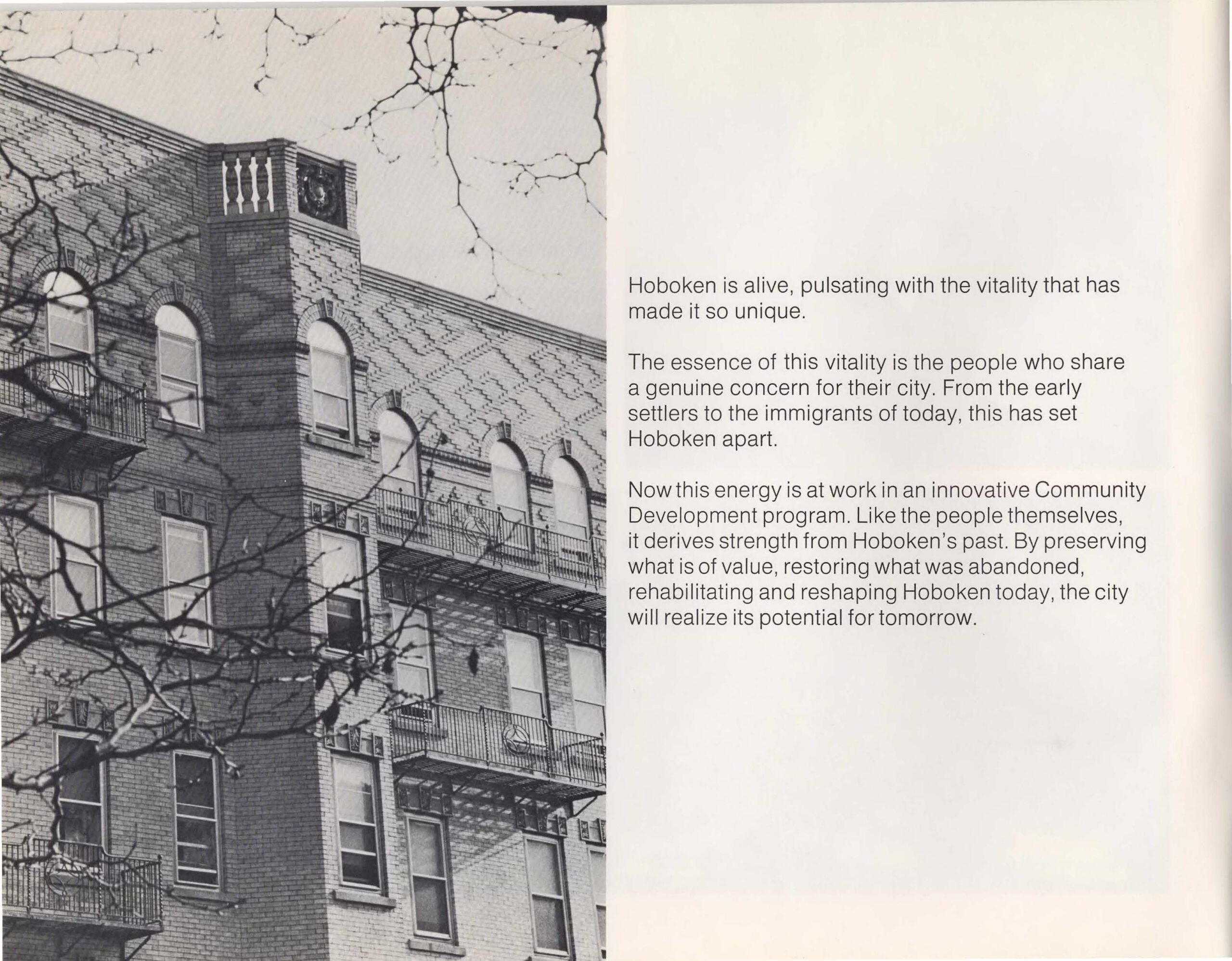
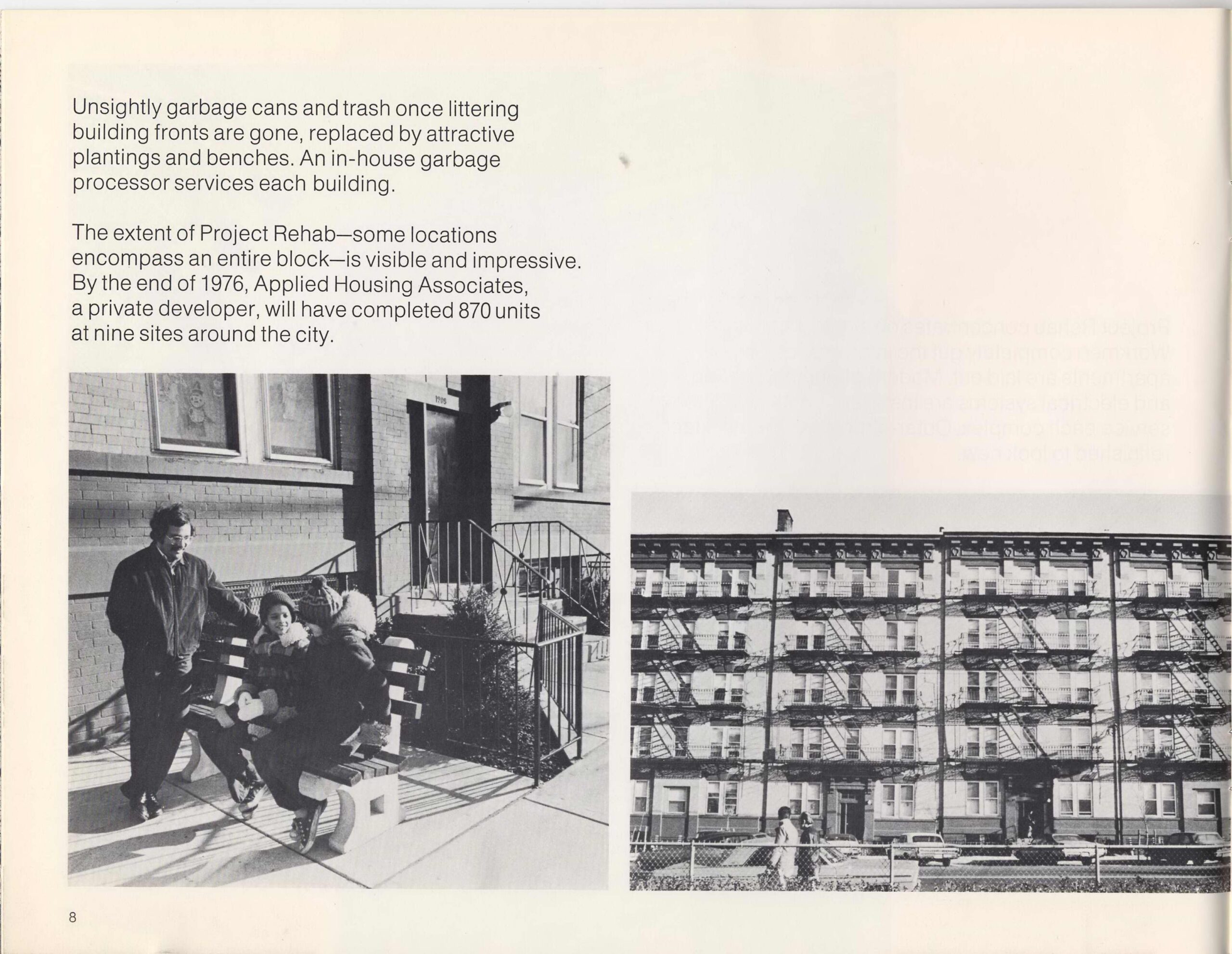
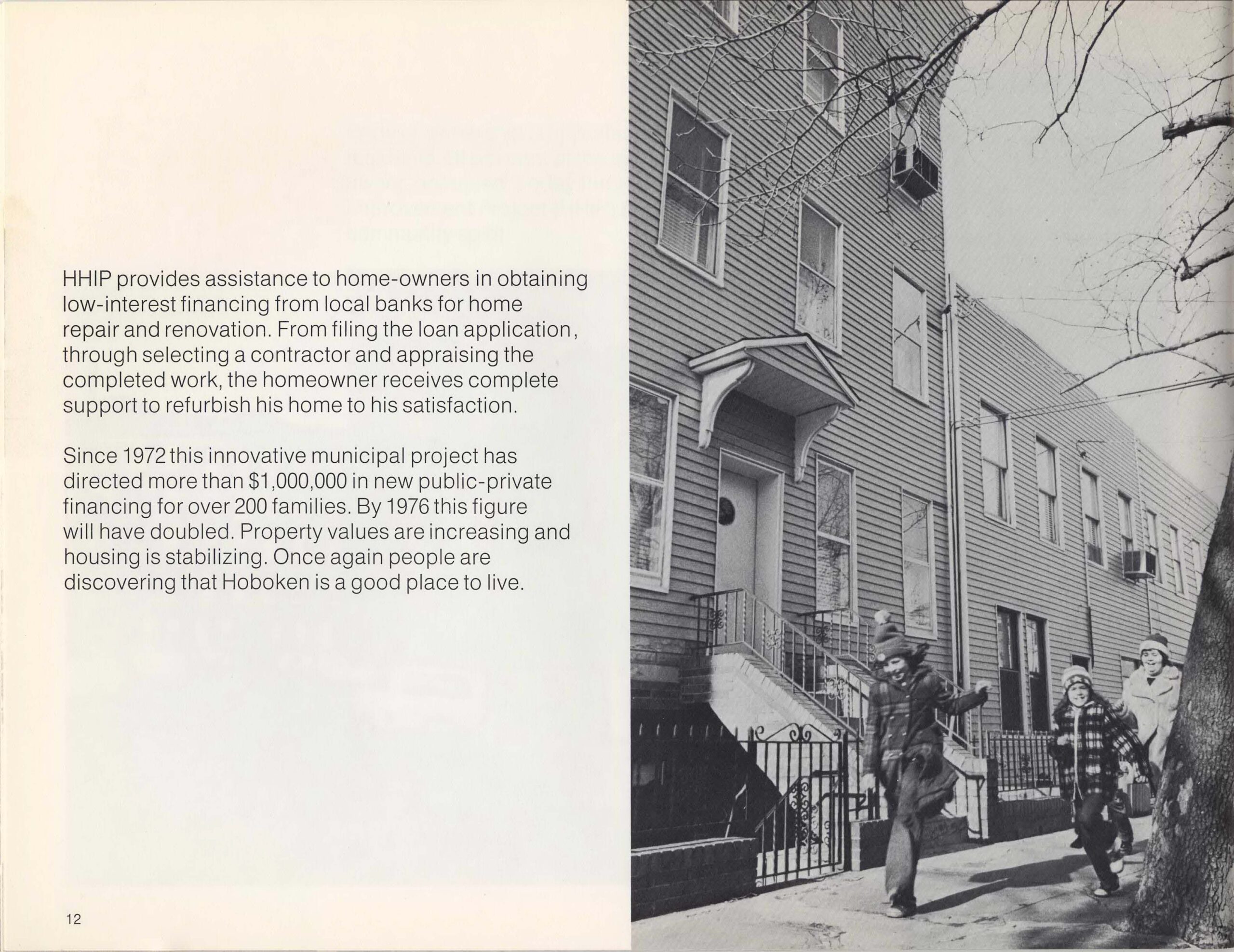
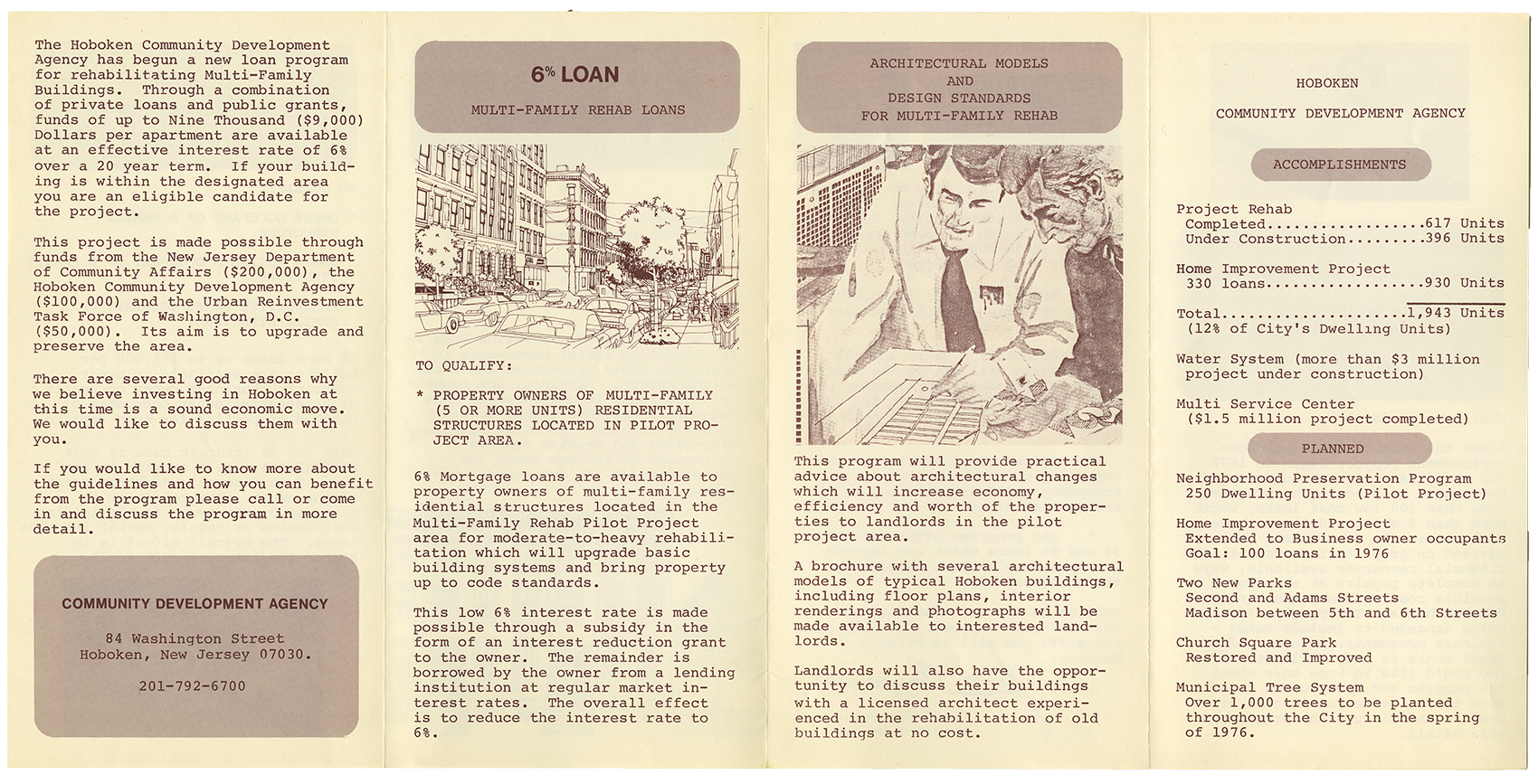
With the brownstone boom well underway, Mayor Steven Cappiello announced that federal Model Cities initiatives (including the Home Improvement Program) would now be directed by a new local public-private body, the Community Development Agency (CDA). Developers would receive a direct infusion of federal dollars to rehabilitate multi unit buildings, and the CDA would launch a public relations campaign to attract upwardly mobile professionals to Hoboken. As a result, owner occupied brownstone rehabs gave way to developers converting tenement buildings into luxury condominiums.

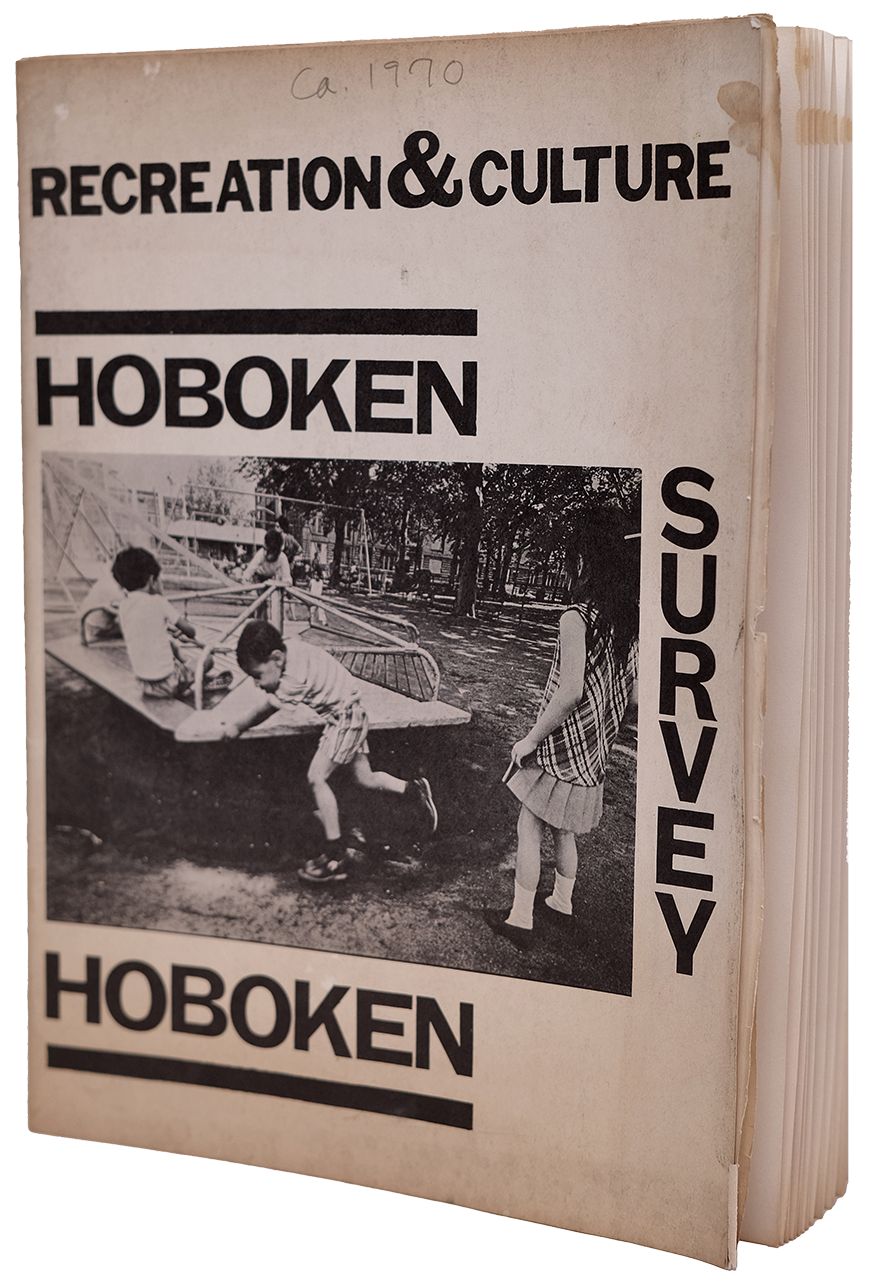
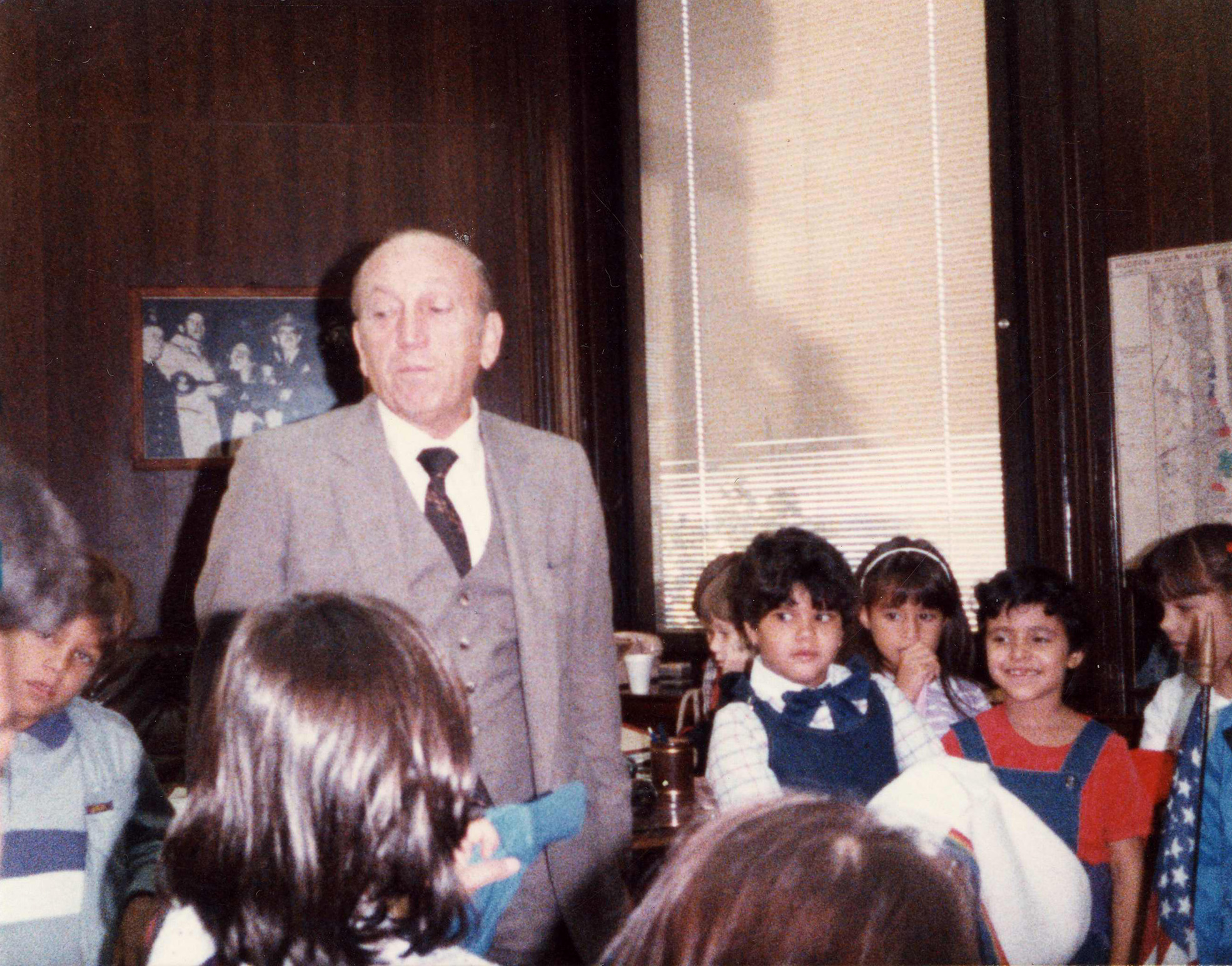
In the mid-1970s, Hoboken and other cities began to pursue a strategy of dispersed urban renewal, partnering with local entrepreneurs and largely eschewing the Model City– era emphasis on poverty relief. Indeed, the shift spelled the end of several programs, including subsidized preschool, which targeted the urban working class.
1976
Attracting Young Urban Professionals
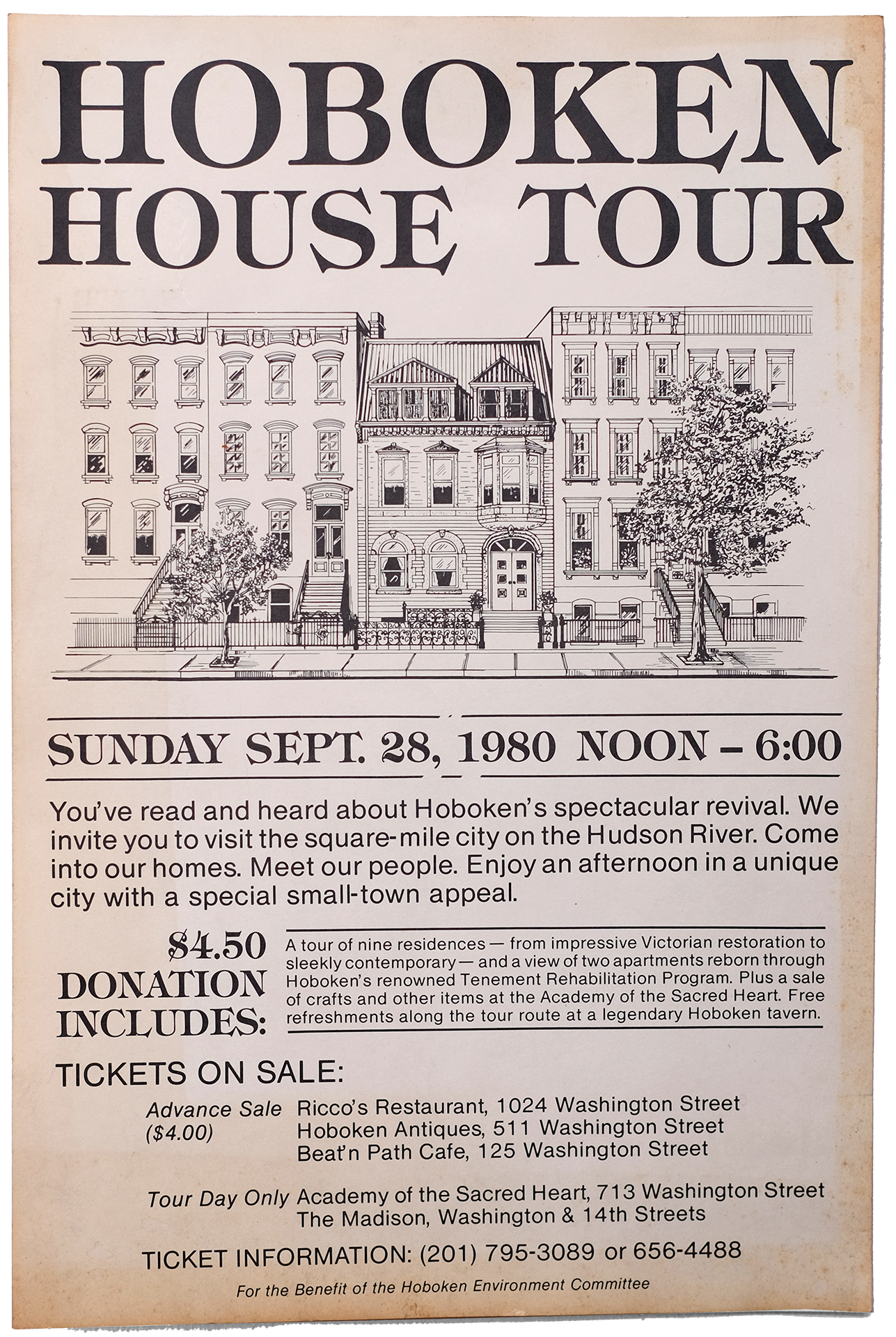
Peter Beronio, a marketer at the Community Development Agency, launched a promotional campaign designed to lure young professionals to Hoboken. Sponsoring public events, printing brochures, and giving optimistic interviews in local newspapers. The CDA created a thirty-stop annotated walking tour, printing pamphlets to distribute to visitors from its office on Washington Street.
The following year, the CDA produced a more elaborate twenty-seven-page visitor’s guide, the cover of which barely pictured Hoboken at all. The CDA had now fixed its sights on a new demographic: New York’s growing cadre of young finance, law, and corporate professionals. Yuppies, the CDA and local developers hoped, would be willing to pay higher rents than current Hoboken residents were for studios and one bedrooms in recently renovated apartments. With unemployment at 17 percent in Hudson County at the end of 1975 and a quarter of city residents on welfare, the capital for a continued real estate revival would have to come from elsewhere. The CDA hoped that private equity could replace sweat equity in Hoboken. The brownstoners of the late 1960s and early 1970s had flocked to Hoboken for its handsome and affordable housing stock, but the new yuppie commuters were more concerned with the short travel times to their jobs in lower Manhattan. Realtors’ ads emphasized proximity to the path train—“1 block from path”; “near path”; “3 blocks from path”— which whisked commuters from Hoboken to Wall Street in under ten minutes for a 30- cent fare.


1978
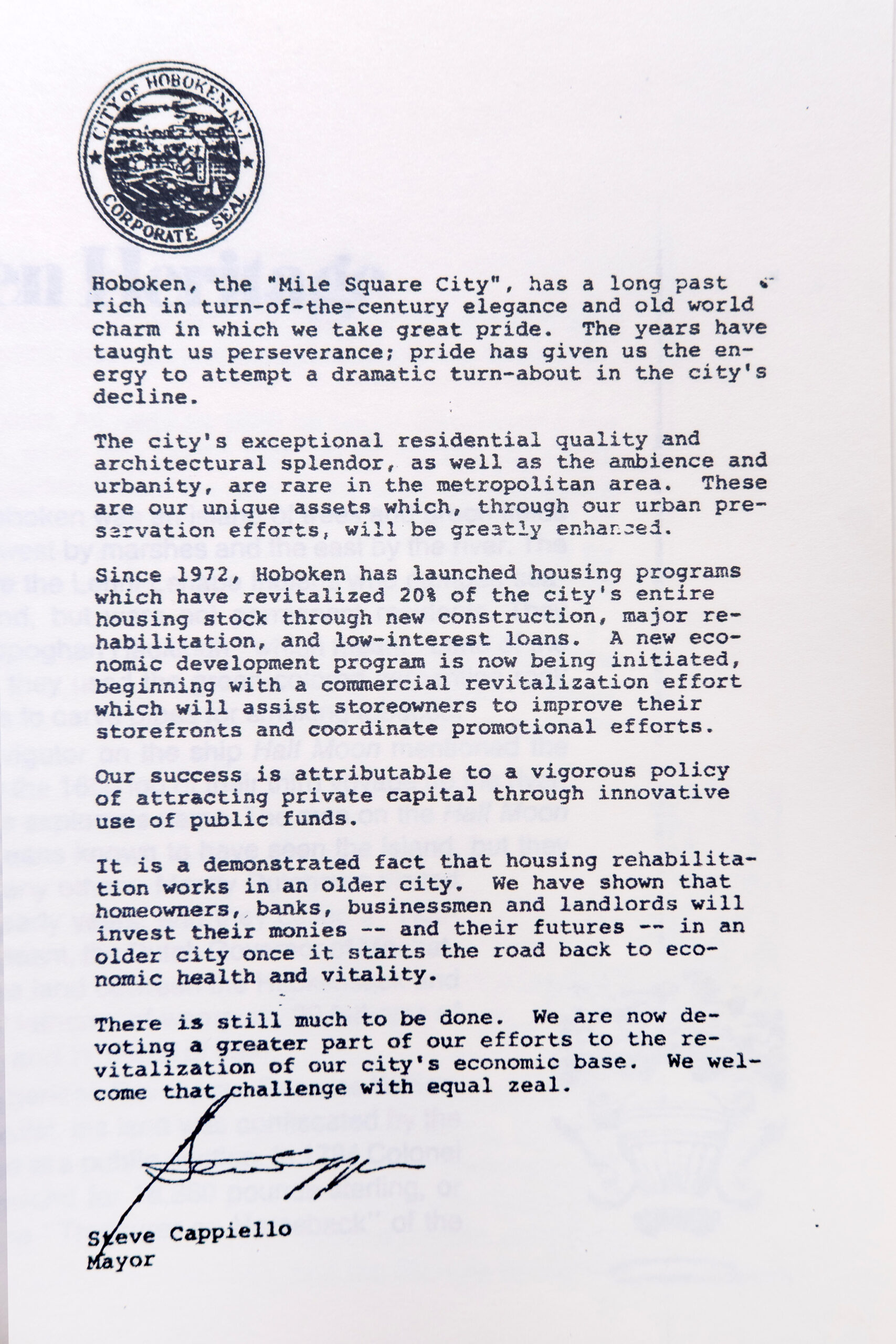
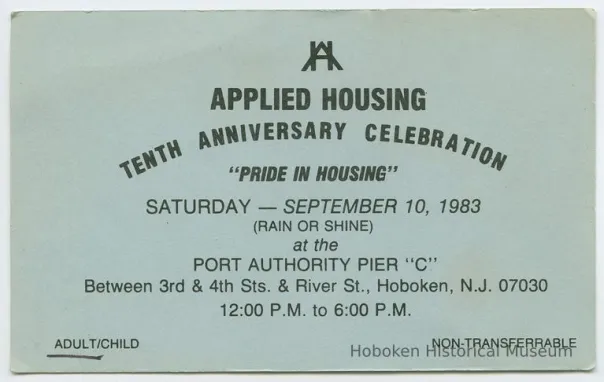
Applied Housing


View Footnote
Yuppies Invade My Home at Dinnertime was published in 1987 shortly after the height of the arson epidemic. The book was published and co-authored by the owner of Hoboken’s largest developer, the owner of Applied Housing, Joe Barry. It comprises a selection of popular op-eds that ran in the Sunday edition of The Hoboken Reporter, a newspaper that was also owned by Mr. Barry. The special edition of the paper acted as a public forum for long-time Hoboken residents and Yuppies to banter and air their grievances in regards to the city’s burgeoning gentrification.
1979
Fire at 131 Clinton Street
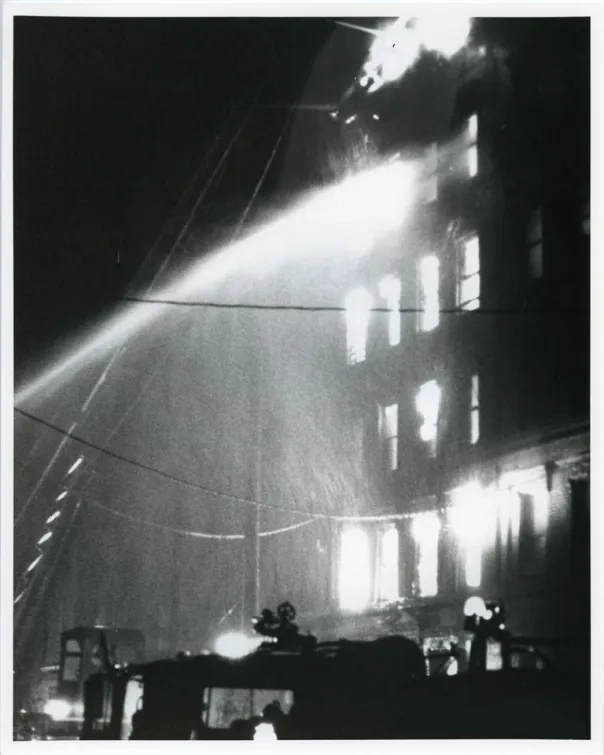
On Jan. 21, 1979, Hoboken sees its worst fire in decades as 21 people were killed and 21 others were injured at 131 Clinton St. This fire marked the beginning of the arson for profit epidemic that would consume the city. The victims, The Rampersads, were identified as Marji Rampersad, 33; her children, Sandra, 12; Inder, 10; Tulsi, 9, Sherman, 4, Bevar, 2 and two other children whose names were not given. The Drepauls, Jacob Drepaul, 38, his wife, Kasturi, 35, and their children: Rosanne, 17, Adrian 16, Bill, 14; Gaita,13; Raymond, 9, Fatbay, 7, and Pealey, 6. Members of the Soto‐Torres family were identified as Placida Soto‐Torres, 53, and her children; Manuel, 21, Teresa, 18, Margarita, 16, and Marilyn, 14. The owner of the building, Olga Ramos, was accused by authorities of the arson but they deny those claims. This fire displaces 130 people.
1980
Deregulation of Banks
The deregulation of the banking sector and the resulting surge in financial and professional employment brought dramatic changes to America’s urban neighborhoods. In those years, cities such as Hoboken absorbed thousands of so-called yuppies—young urban professionals. On the blocks around Hoboken’s path (Port Authority Trans-Hudson) station, where trains whisked commuters through tunnels to Wall Street in under ten minutes, the proportion of residents working in professional or managerial jobs leapt from one in twenty in 1970, to one in three by 1980, to one in two by 1990. Those commuters, almost all of them single or childless, wanted a very specific sort of housing: studios and one-bedrooms with upscale appointments. Along the blocks closest to the waterfront, where many buildings enjoyed views of the Manhattan skyline, the percentage of professional and managerial workers quadrupled during the 1980s; their ranks increased eightfold in the Uptown neighborhood just to the north. The proportion of professionals and managers at the southern end of Washington Street jumped from 5.8 percent in 1970 to nearly 34 percent by 1980. And on the blocks surrounding the path station, over 10 percent of residents were employed in finance, insurance, or real estate jobs, up from just 1 percent in 1970.

The supply of high-end apartment rentals and condos could not keep up with young professionals’ demand. In 1981 Hoboken’s residential vacancy rates fell under 1 percent. (By comparison, New York City’s vacancy rate was then 3 percent.) Two reasons caused this housing shortfall. The first was the widespread conversion of brownstones from multiple units back into single-family residences by middle-class homesteaders. Second, apartments in the city’s walk-up tenement buildings, which still made up one-third of Hoboken’s housing stock, were overwhelmingly occupied by families who enjoyed rent control on their seven-hundred-square-foot railroad flats. For landlords of those five-story tenements, profit beckoned. Yet New Jersey law compelled landlords to give tenants three years’ notice prior to converting to condos, and occupants could apply for up to five additional one-year extensions. Eager to cash in quickly on yuppies’ strong demand for renovated apartments, landlords sought to remove their rent-controlled tenants with an organized program of harassment, neglect, and, most terrifyingly, arson.
1981
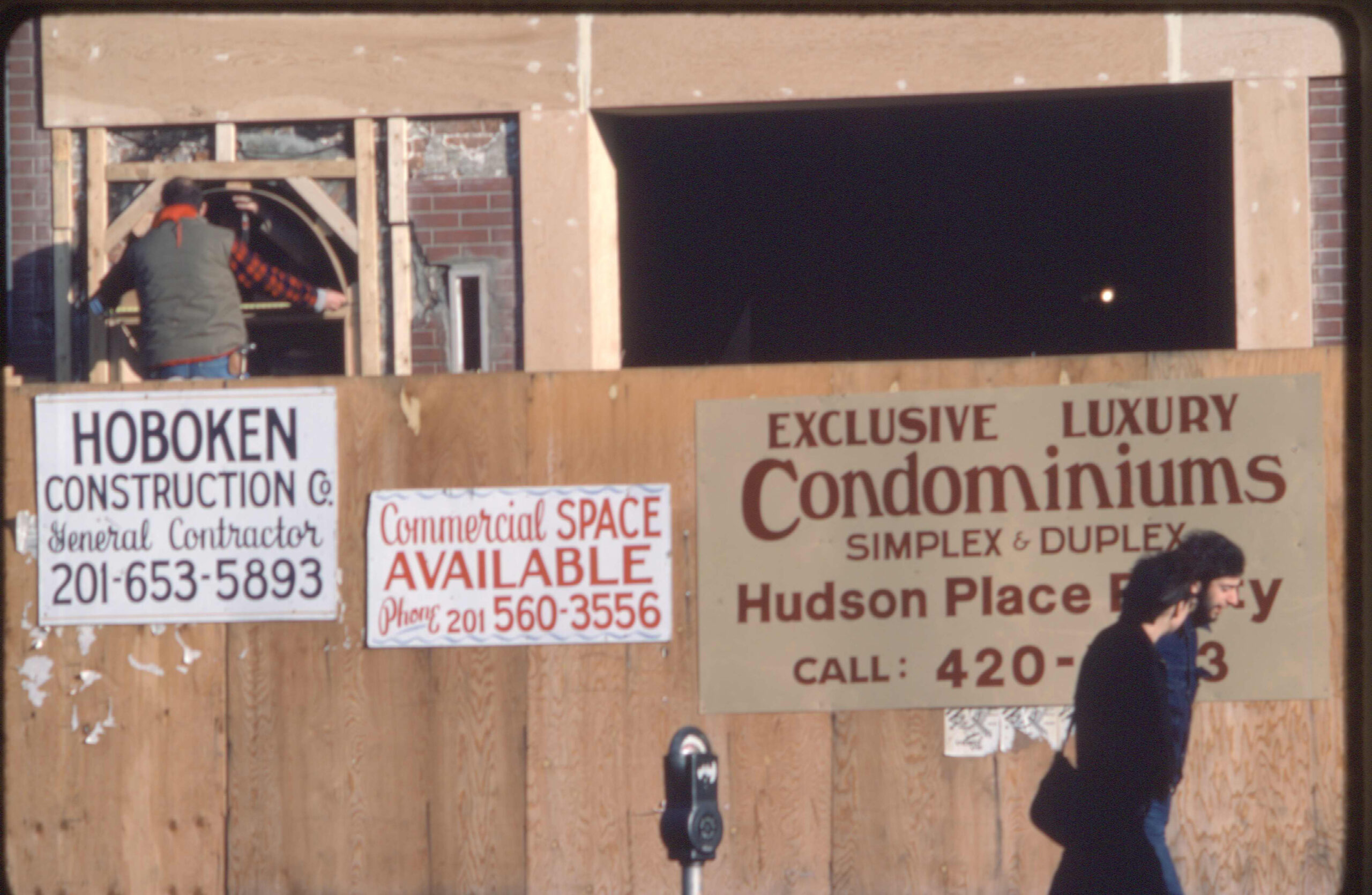
Vacancy Decontrol and Arson
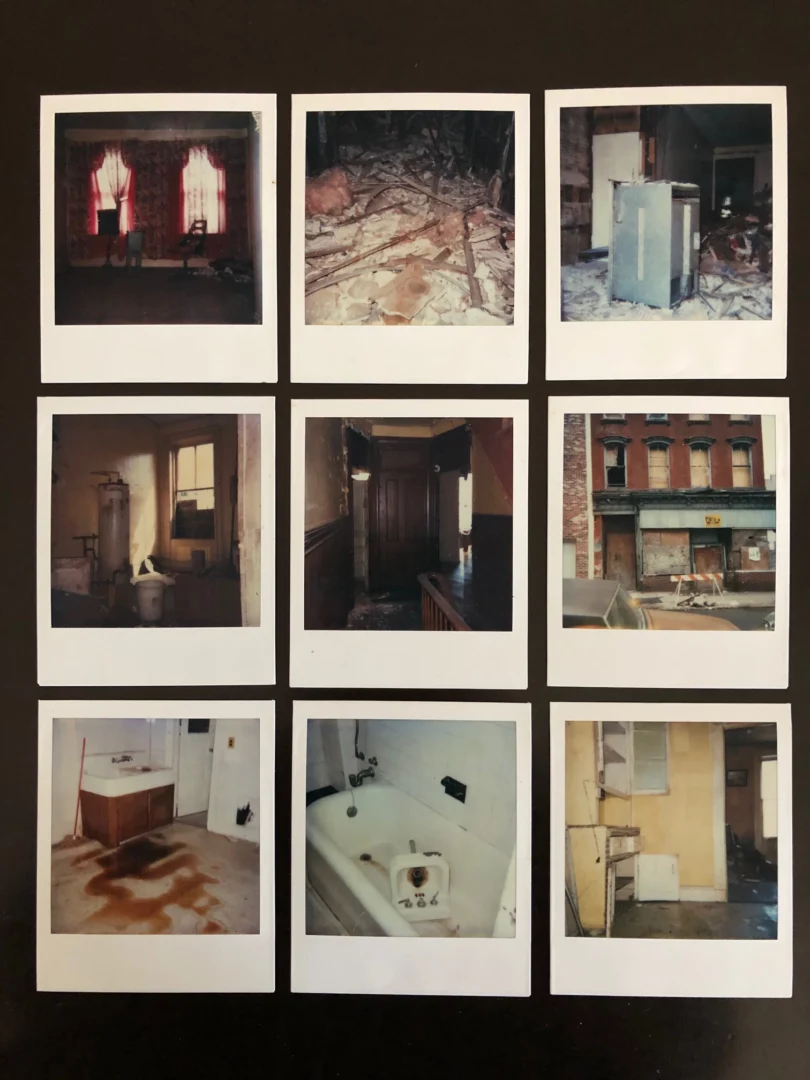
Hoboken’s city council undermined the city’s rent control laws making it easier for tenants to be evicted. Before resorting to arson, some city landlords had taken advantage of loopholes in the city’s rent-control law to try to replace poorer tenants with better-off newcomers. One statute allowed owners to decontrol rents if they made capital improvements equaling 50, and later 100, percent of the structure’s (artificially depressed) value. After finishing the mostly unnecessary work, a landlord could have doubled and tripled rents. For residents subsisting on Aid to Families with Dependent Children, pensions, or unsteady wages, such a rent increase was simply unsustainable. Most of the building’s tenants left “voluntarily,” or were paid off, and their apartments were re-rented at market rates.
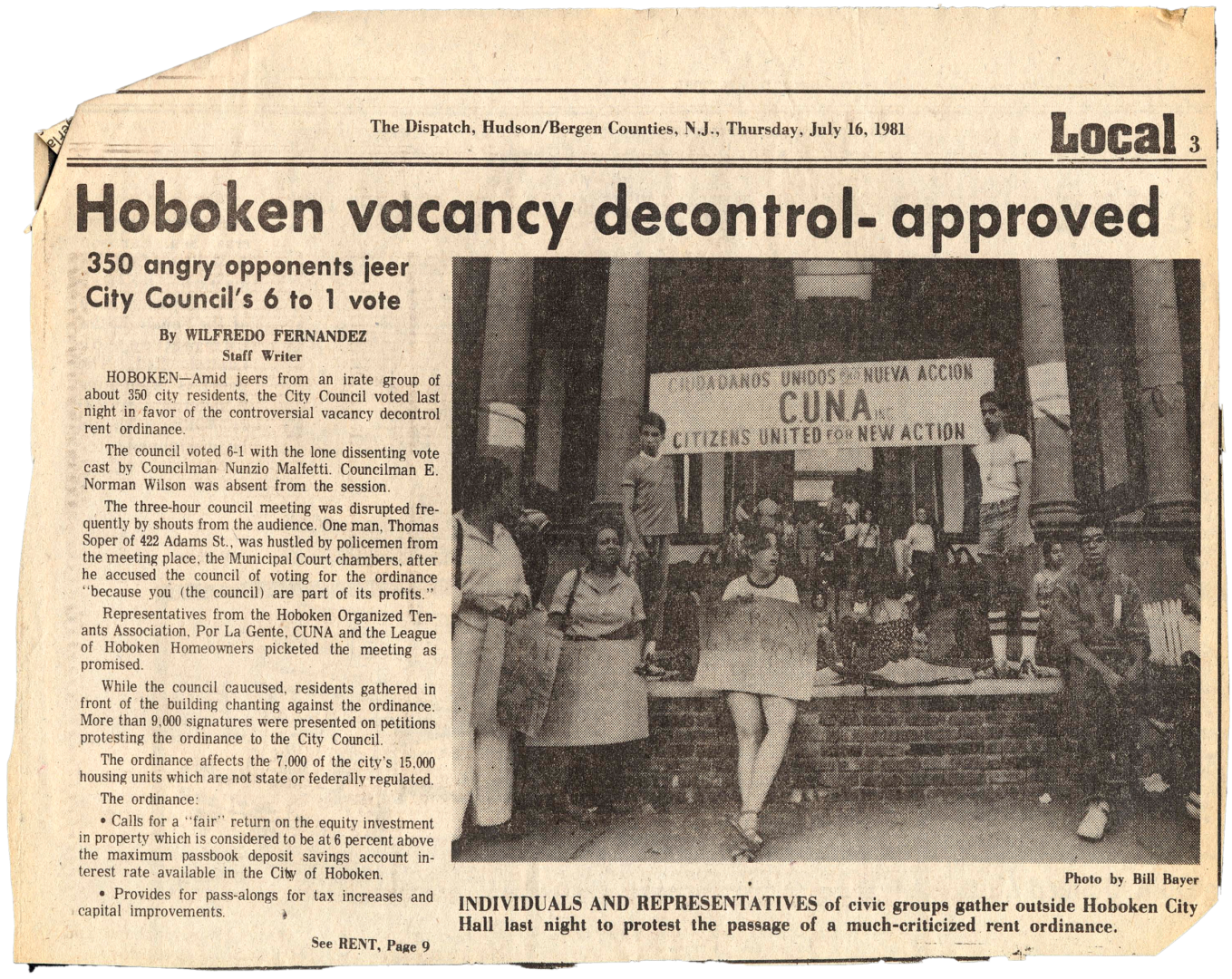
The Hoboken City Council passed two pro development measures that made arson a more lucrative option than removal by renovation. The new rules weakened rent control laws, and encouraged landlords to find a way, any way, to replace their low-income tenants with well-off renters. The first measure allowed a “hardship increase” that permitted owners to hike up rents if they could demonstrate that they did not make at least an 11.5 percent yearly profit from each unit. Even more pernicious was the vacancy decontrol law, which the council passed over the objections of tenants-rights organizations and a petition of opposition signed by nine thousand residents. It allowed landlords to raise rents to “whatever the market could bear” if rent-controlled occupants vacated their apartments. Owners could now dispense with the charade of capital improvements and shift their efforts to tenant harassment and intimidation. That year, arson became an almost daily scourge.
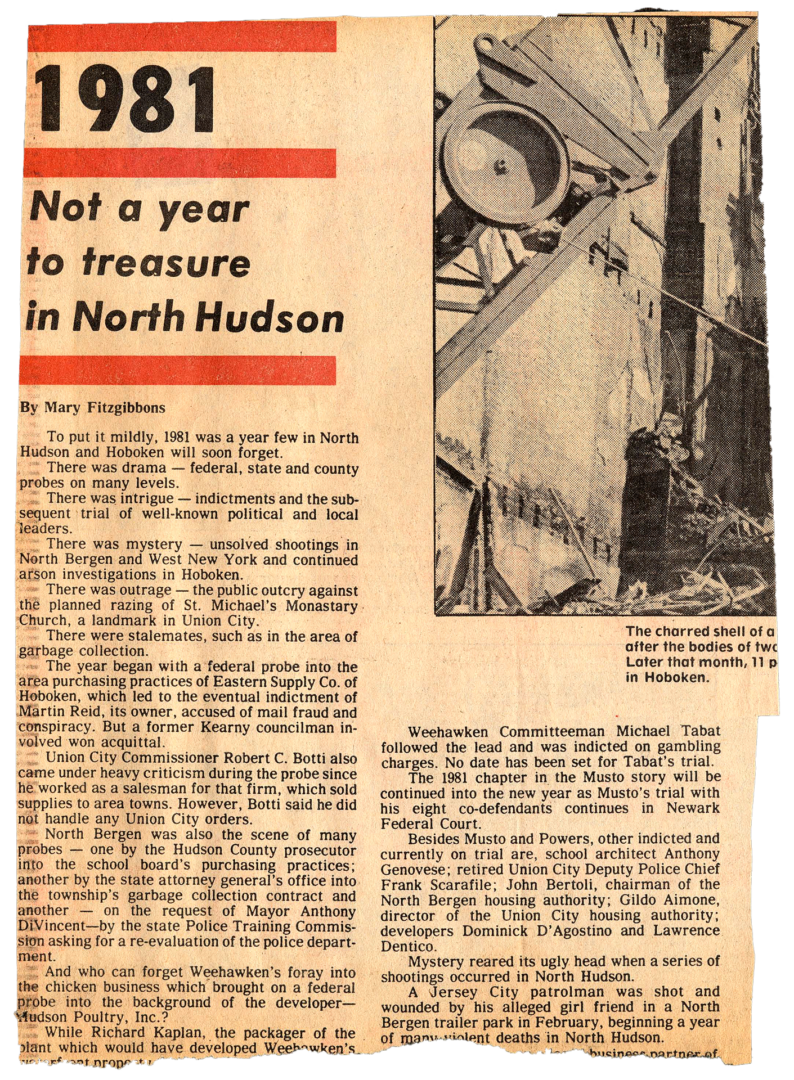
In April four arson-related fires over two days displaced sixteen families. A multi alarm blaze on July 30 left seventeen more families homeless.That summer, three arson-related fires filled the five-story apartment building at 411 First Street with thick smoke. The owner, an absentee landlord, had repeatedly threatened her tenants that she would remove them, even if she had to resort to arson. And on September 2, a suspicious fire—the fourth that year—gutted the top floors of a building at Third and Madison Streets. Fifty-one residents, almost all Puerto Rican, were unable to return to their apartments. Most were unable to find another apartment in Hoboken’s inflated rental market. Hoboken Housing Authority director Joseph Caliguire was not sanguine about rehousing those displaced by the fire: “It will be almost impossible. The vacancy rate is nil. And in most cases, if there was a vacancy, they wouldn’t be able to afford it.”
1981
Tenants Combat Arson
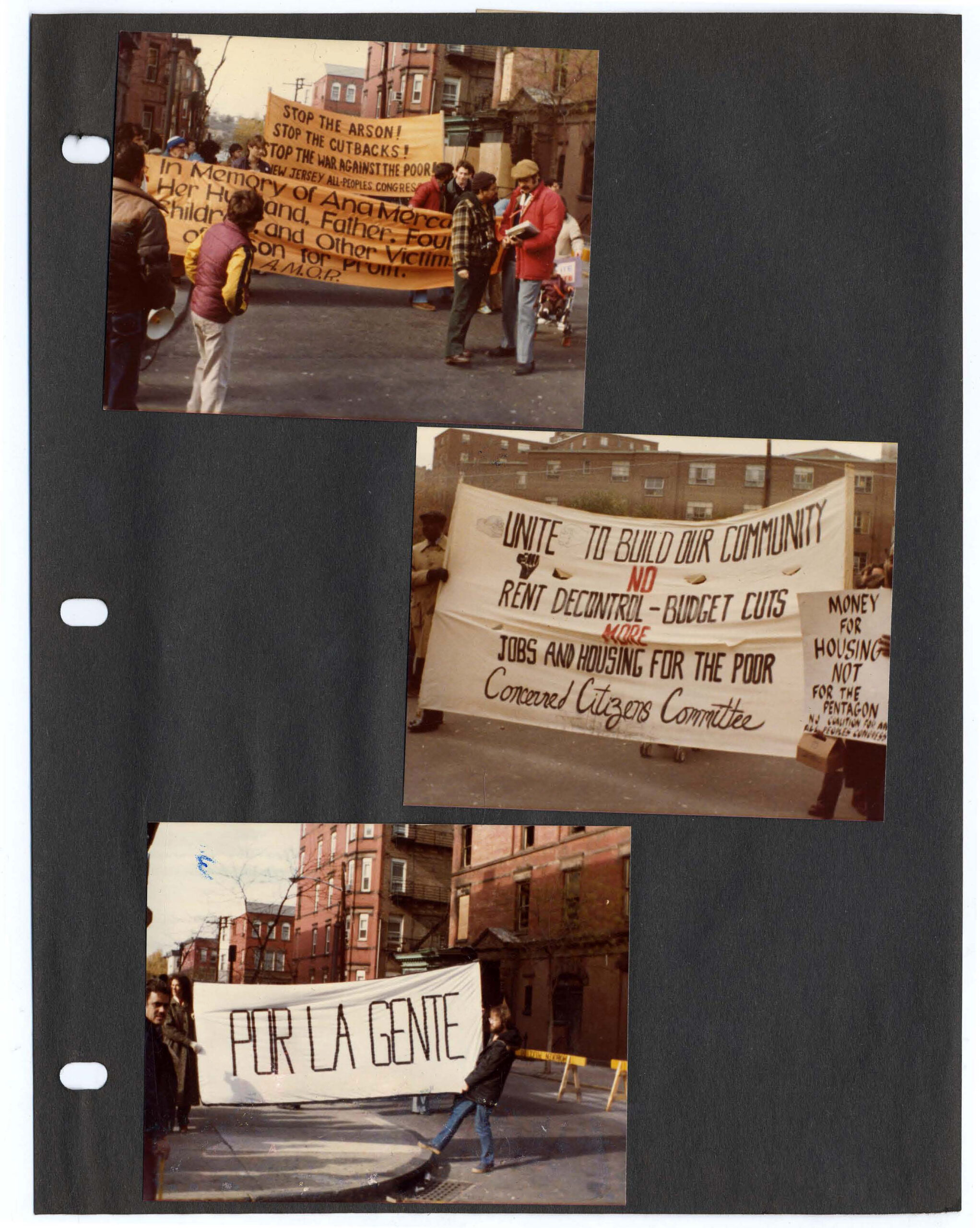
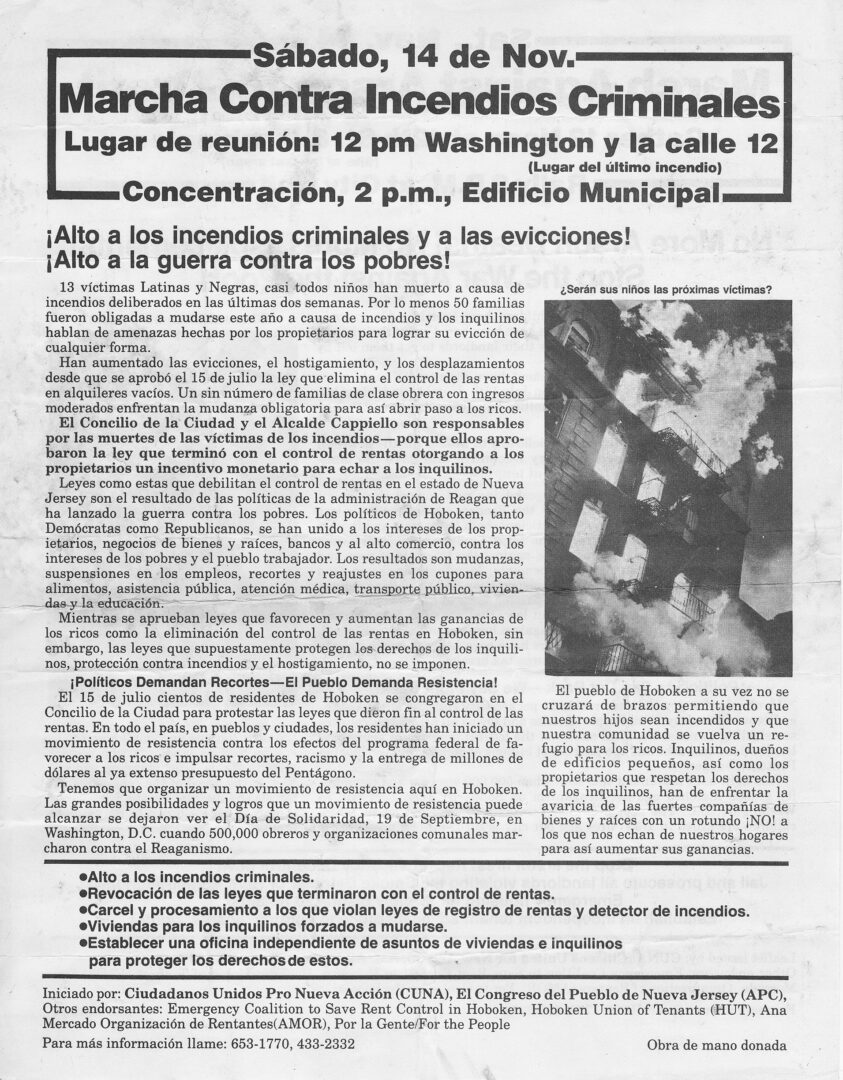
Hoboken’s low-income tenants organized several groups to combat the arson campaign and the city ordinances that had encouraged it. In 1981 Puerto Rican residents and local Catholic clergy founded Por la Gente, which joined the recently formed tenants groups Emergency Coalition to Save Rent Control in Hoboken and Citizens United for New Action (cuna, an acronym chosen because it means “cradle” in Spanish). Working together, these groups used direct action tactics to protest the arson wave. They papered the city with flyers that blamed gentrification for the fires. Tenants, they promised, would “not sit by while children are killed in arson fires” and Hoboken was “turned into a preserve for the rich.” Above an image of a building engulfed in flame, block letters declared, “No more arson deaths! No more displacement! No more war against the poor!” At 1327 Willow Street, residents and Por la Gente volunteers began an around-the-clock arson watch. Meanwhile, Hoboken’s Tenant Union (an umbrella organization that included Por la Gente) challenged the city’s vacancy decontrol laws on legal and political grounds, with no immediate success. The union also appealed to the Hudson County and New Jersey district attorneys to investigate the arson for profit.
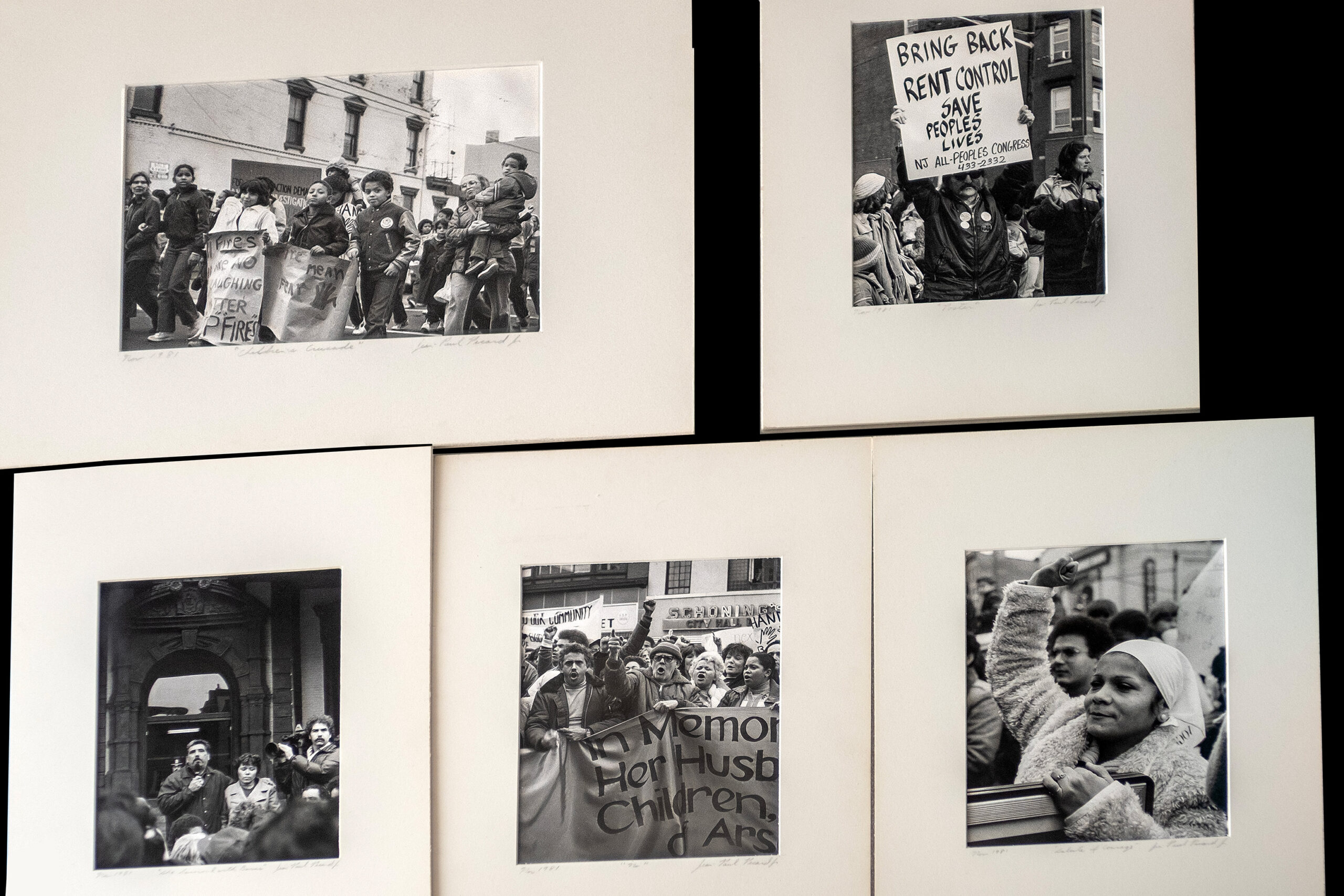
Photos by Luc-Picard
1981 - October 13th
Arson at 67 Park Avenue

View Footnote
An image found in the rubble of Modesto Echevarria who died with his younger brother Juan in the fire. They were found days later together in the bathtub of their apartment. Original photo captured by Chuck Sutton, re-photographed by Christopher López
Three adjacent buildings at 65, 67 and 69 Park Ave. were consumed by an arson fire. The victims were 2 young boys, Javier Rosa, 2, and Modesto Echavarria, 7. Their mother and sister survived a jump out their third-story window, the two boys were found together in their bathtub. Several fire attempts were extinguished in the building by tenants prior to the last attempt that took place. At the time of the fire, the building’s smoke detectors were either missing or broken, and its fire alarms had been disabled. That night, thirteen more people were injured and one hundred, almost all Puerto Rican, were left homeless.
1981 - October 24th
Arson at 1202 Washington Street (El Dorado)
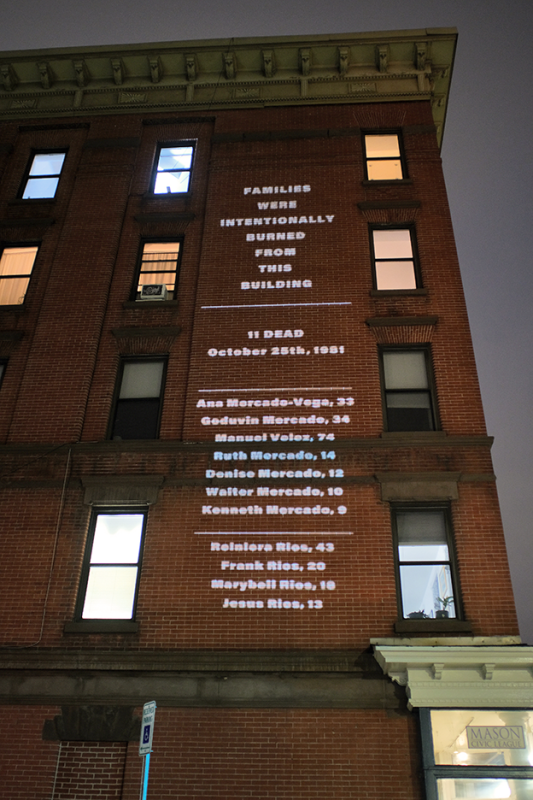
Only within a few days of the Park Ave. fire, another arson fire took the lives of 11 people at 1202 Washington Street. As was the case with the Park Ave. fire, and the vast majority of buildings that saw arson, smoke detectors and fire alarms were either non functioning or dismantled. A liquid acceleration ignited from the first floor was found to be the cause. Several arson attempts were made prior but extinguished by tenants. Weeks before the fire, the owner, Olga Ramos, had threatened to remove her tenants by any means even if she had to burn them out. A formal complaint of this threat was made at city hall and initialed by a city official. Ms. Ramos was also the proprietor of 131 Clinton street that took the lives of 21 people 2 years prior. Ms. Ramos was questioned by authorities but never charged. Police investigators would come to publicly announce that they had no real leads. 2 families died in the fire of Puerto Rican and Cuban descent. The victims from the fifth floor were The entire Mercado family, mother Ana Mercado 33, Godovin Mercado 34, Ana’s father, Manuel Valez, 74, and the Mercados children, Ruth 14, Denise 12, Walter 10, and Kenneth 9. On the fourth floor, The Rios family, mother Reineira Rios, 43, and her children, Frank, 20, Marybell, 18, and Jesus 13.
1981 - November 14th
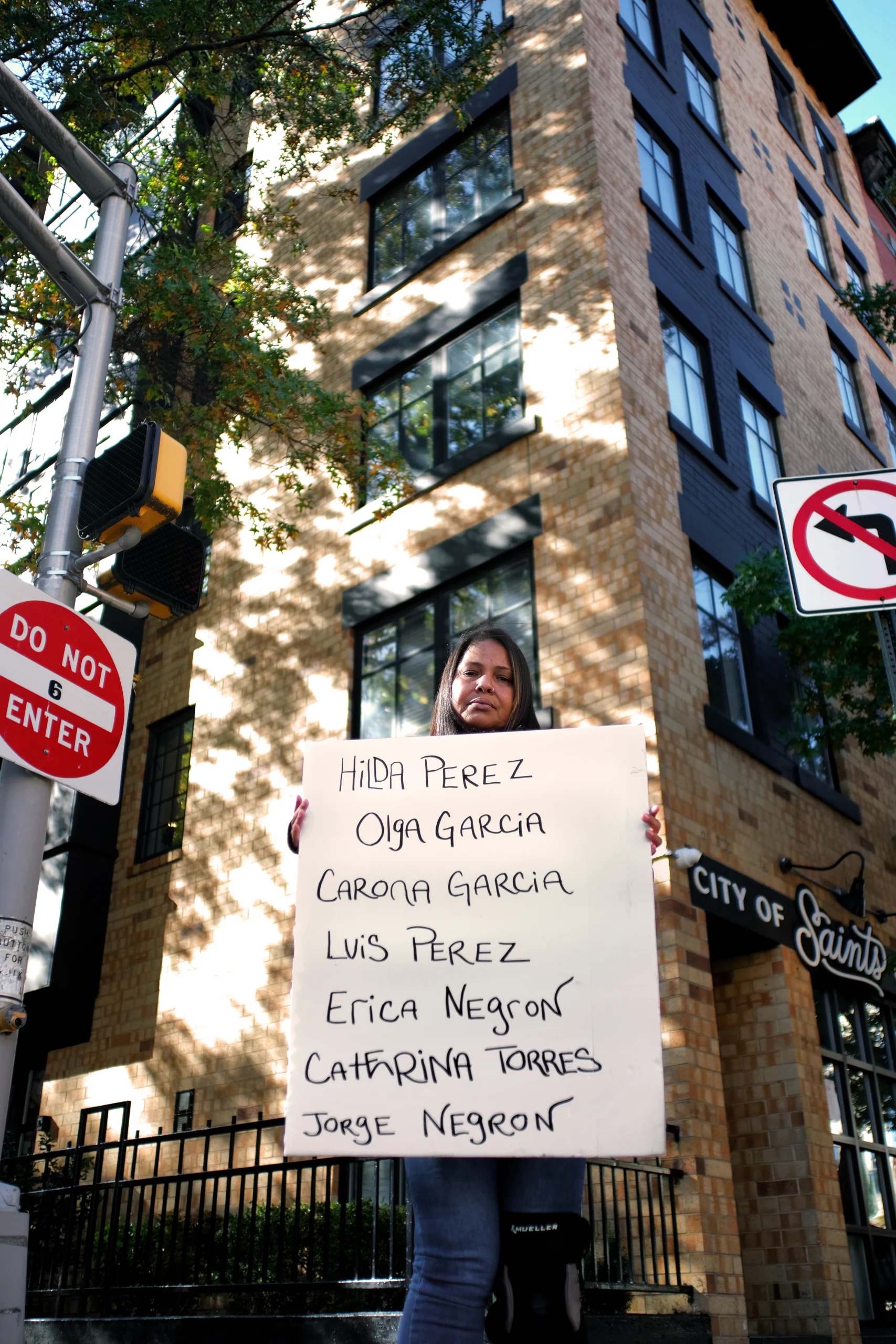
Anti-Arson March
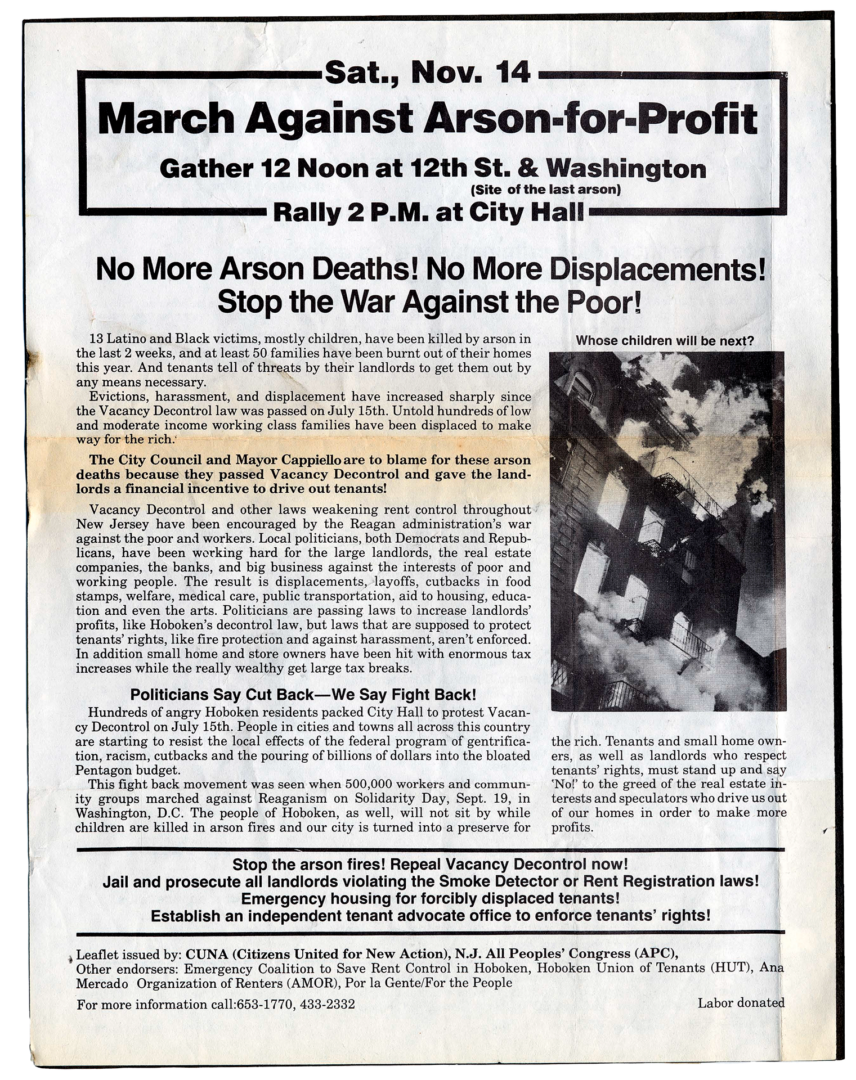
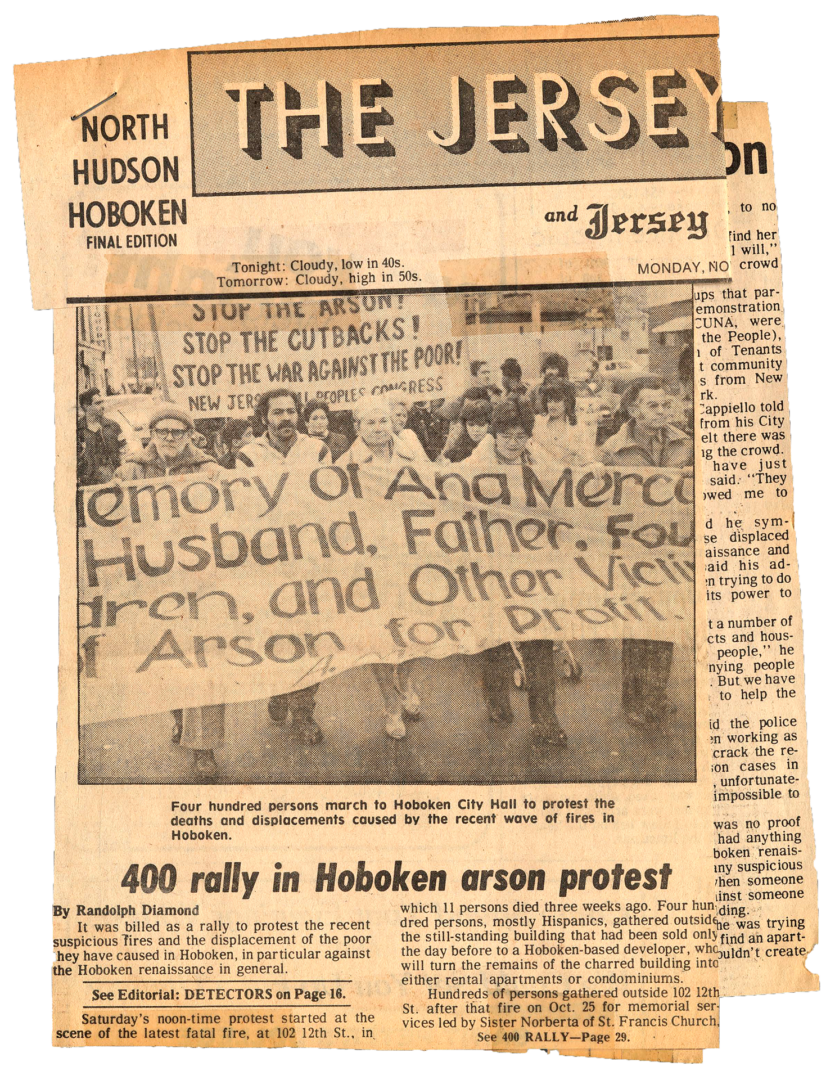
Tenants rights activists held an anti arson march that began in front of the burned-out building at 12th and Washington. Over four hundred residents joined in the protests, carrying signs bearing the names of fire victims. Organizers used the demonstration to publicize the sheer scale of displacement in Hoboken: some ten thousand people, according to one CUNA representative. The arson-related death toll, he added, was forty-one since March 1978. Tenants-rights activist Tom Soto encapsulated tenants’ grievances. “They are trying to push the poor people out to make this an exclusive upper-middle-class community,” he said at a Por la Gente meeting. “The landlords, for their own profit, are being encouraged to push out the poor.” Arson, he argued, constituted “an offensive against the poor.”
Even as public protests and media attention mounted, the arsons for profit continued. In November 1981 the American Hotel, a five-story single-room-occupancy building, went up in a fatal blaze that investigators determined had been set by arsonists. The hotel’s owner had been under contract to sell the building to a developer for $500,000 under the condition that it be “delivered vacant.”
1982 - April 30th
The Pinter Hotel Fire
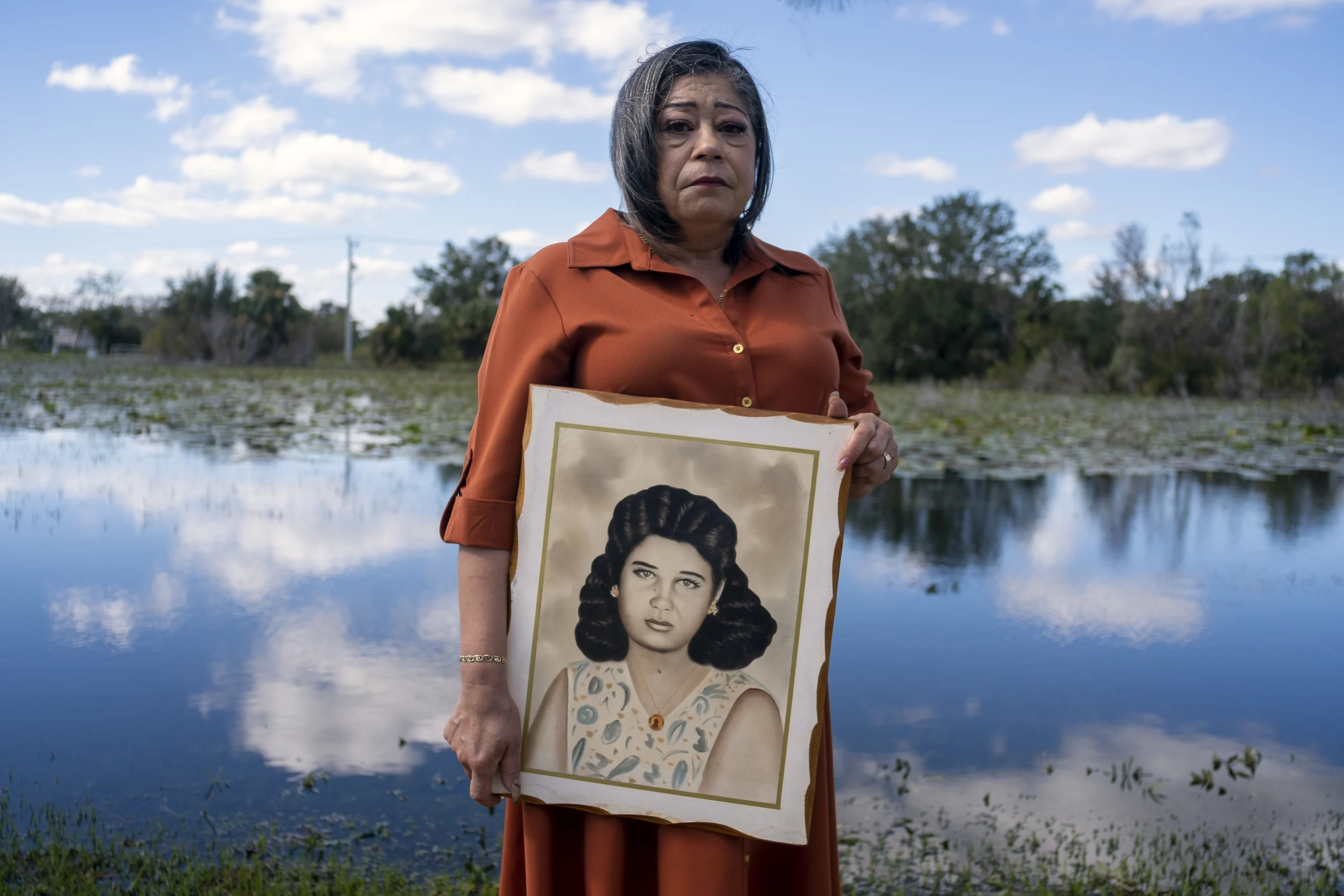
13 were killed at the site of the Pinter Hotel at 151 14th St. The victims: Hilda Perez, 48; her grandson, Angel Perez, 8; Mrs. Perez’s daughters, Olga Garcia, 22, and Luz Delia Garcia, 17, Olga Garcia’s daughter, Katelin Torres, 4 months, and Luz Delia Garcia’s two children, Jorge Negron, 1, and Erica Negron, 3 weeks. Also identified as victims were Juan Serrano, 32; his son, Charles, 3, Mr. Serrano’s wife, Francisca Vasquez, 42, her son, Ismael Vasquez, 15, and Xavier Calon, 4. Witnesses watched as desperate mothers dropped their infants from windows to passersby before jumping out themselves.